Escolha os dados enviados
Nenhuma app é selecionada automaticamente. Escolha apps, palavras opcionais e destinos.
 Push Notifications to Webhook
Android · HTTPS · Webhooks
Reencaminhe notificações das apps Android escolhidas para os seus webhooks HTTPS. Filtre por palavras, acompanhe envios e mantenha o controlo.
Android 12+ · Publicação em preparaçãoNenhuma app é selecionada automaticamente. Escolha apps, palavras opcionais e destinos.
O histórico mostra pendentes, em envio, entregues e falhadas. Pode reenviar mesmo após uma entrega bem-sucedida.
A captura continua ao sair do ecrã. Fechar e parar suspende captura e envios até abrir novamente.
HTTPS, assinatura HMAC-SHA256 opcional, apenas Wi-Fi e conservação local configurável.
Leia o aviso e aceite para ativar a captura. Pode retirar o consentimento nos Ajustes.
O Android pede uma permissão separada. Verifique o aviso de estado e as restrições de bateria.
Introduza uma URL HTTPS nos Ajustes, depois apps e palavras. Cada app pode usar a sua própria URL.
Capturas mostra estado, tentativas e JSON. Experimente a demo fictícia antes da sua integração.
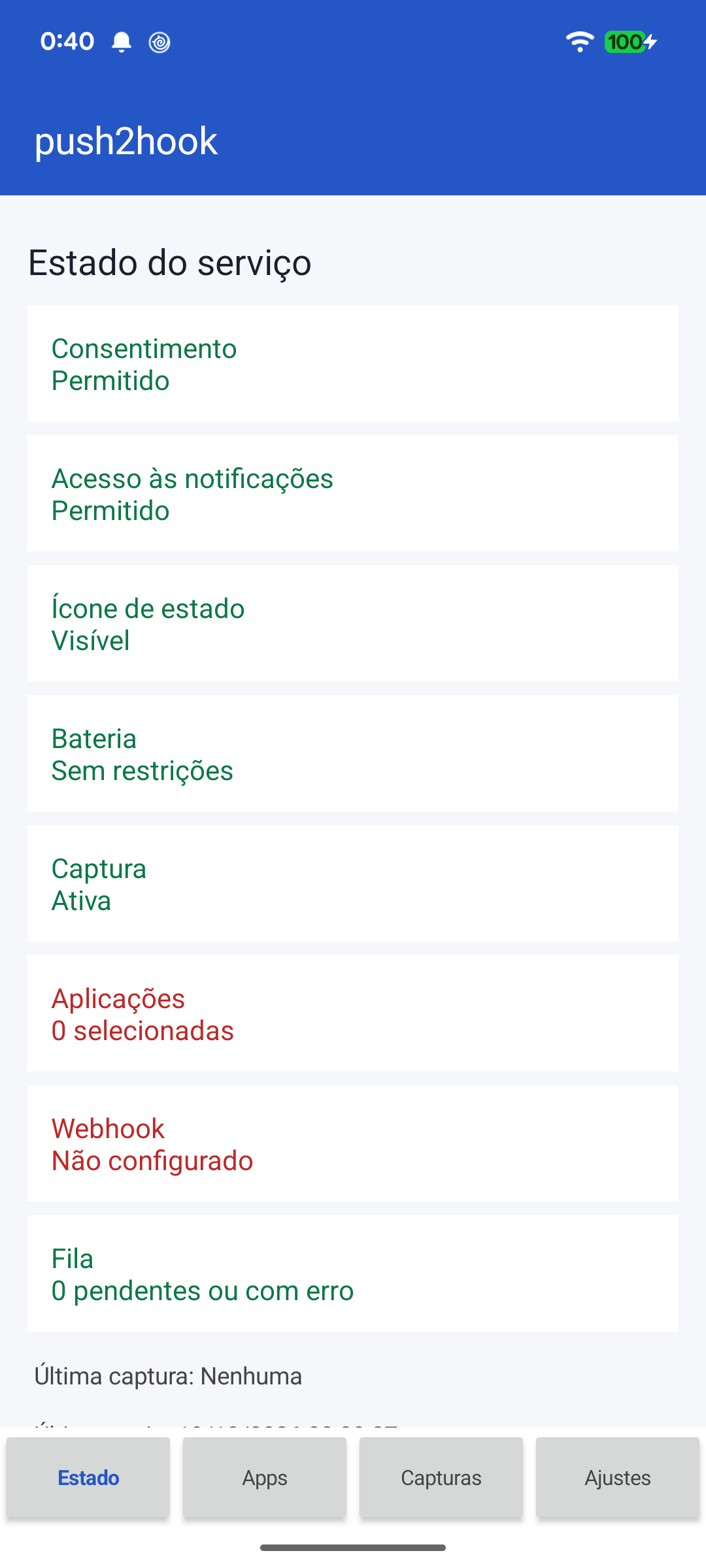
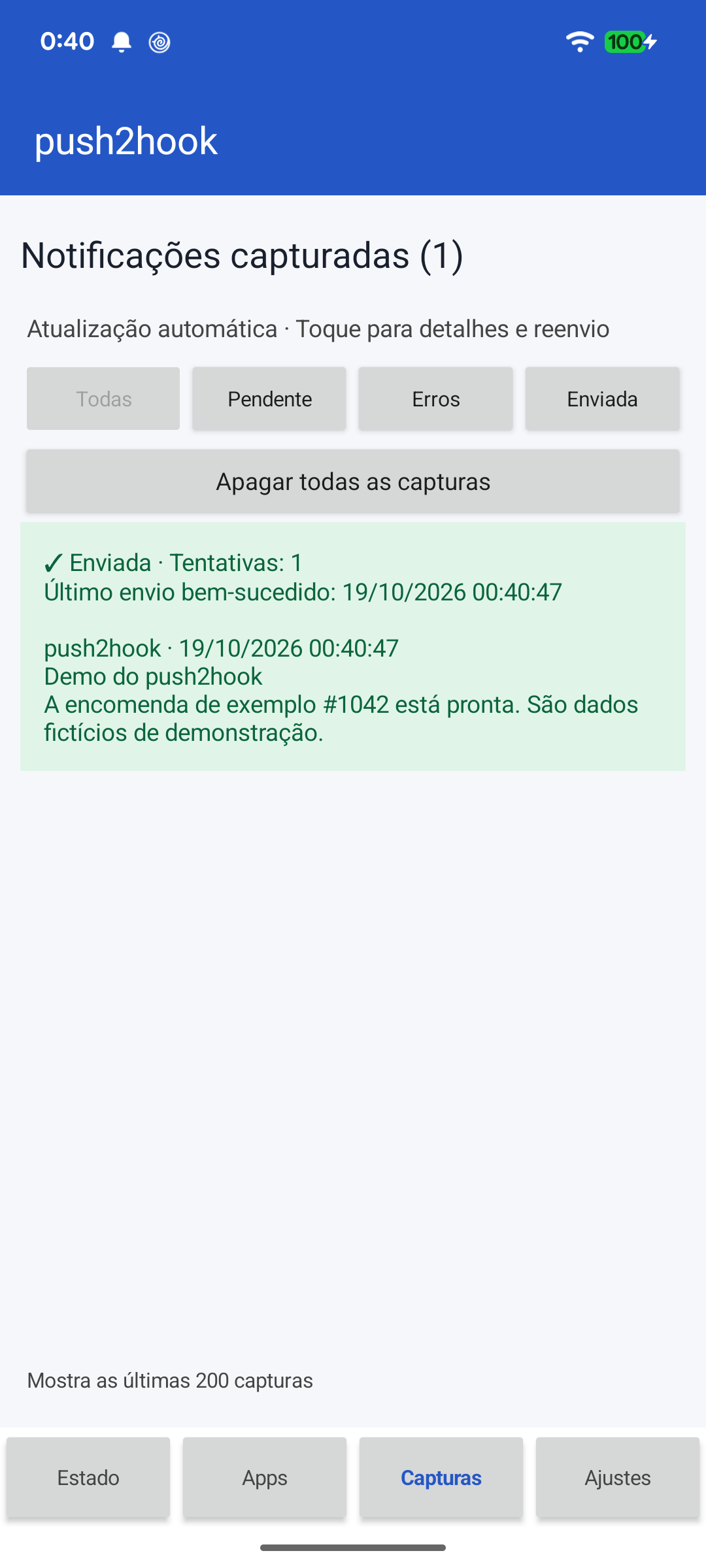
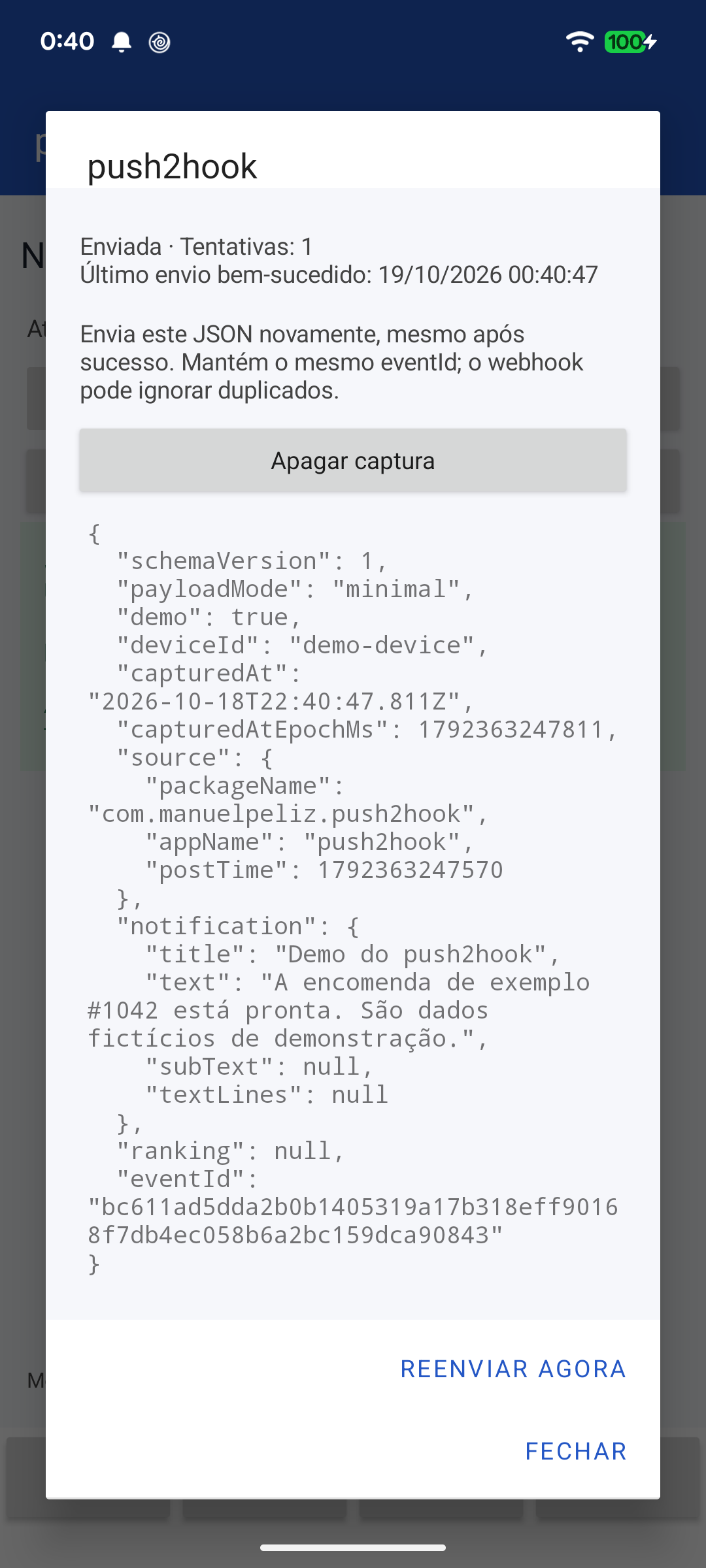
Exemplo do corpo: X-Device-Id deve corresponder a deviceId. X-Timestamp é a hora Unix atual em segundos, não capturedAt.
POST /webhook HTTP/1.1
Content-Type: application/json; charset=utf-8
X-Device-Id: my-phone
X-Timestamp: <unix-seconds>
X-Signature: <Base64 HMAC-SHA256>{
"schemaVersion": 1,
"payloadMode": "minimal",
"demo": false,
"deviceId": "my-phone",
"eventId": "stable-event-id",
"capturedAt": "2026-10-19T10:30:00Z",
"source": {
"packageName": "com.example.orders",
"appName": "Orders",
"postTime": 1792405800000
},
"notification": {
"title": "Order ready",
"text": "Example order #1042",
"subText": null,
"textLines": null
},
"ranking": null
}X-Signature = Base64(HMAC-SHA256(secret, timestamp + "." + rawBody))
Ver recetor do servidorO servidor recebe o POST acima. Escolha Node.js, PHP ou Python para validar e guardar a notificação.
Ver JSON enviadoNode.js 20+, sem dependências. Execute node receiver.mjs atrás de um proxy HTTPS; escuta apenas em 127.0.0.1:8000 (ou PORT).
// Node.js 20+, standard library only. Run behind an HTTPS reverse proxy:
// node receiver.mjs (listens on 127.0.0.1:8000, or PORT).
// Configure PUSH2HOOK_DEVICE_ID, PUSH2HOOK_SECRET (32+ UTF-8 bytes),
// PUSH2HOOK_INBOX: an existing private directory outside the web root.
import { createServer } from 'node:http';
import { createHash, createHmac, randomUUID, timingSafeEqual } from 'node:crypto';
import * as fs from 'node:fs/promises';
import { isAbsolute, join } from 'node:path';
import { TextDecoder } from 'node:util';

const MAX_BODY = 1048576;
const isObject = value => value !== null && typeof value === 'object' && !Array.isArray(value);

const server = createServer(async (request, response) => {
  const reply = (status, message = '') => {
    request.resume();
    const body = message ? JSON.stringify({ error: message }) : '';
    response.writeHead(status, {
      'Content-Type': 'application/json; charset=utf-8',
      'Cache-Control': 'no-store', 'X-Content-Type-Options': 'nosniff',
      'Content-Length': Buffer.byteLength(body), ...(status === 405 ? { Allow: 'POST' } : {}),
    });
    response.end(body);
  };
  const header = name => typeof request.headers[name] === 'string' ? request.headers[name] : '';
  let temporary;
  try {
    if (request.method !== 'POST') return reply(405, 'POST required');
    if (header('content-type').split(';', 1)[0].trim().toLowerCase() !== 'application/json') {
      return reply(415, 'application/json required');
    }
    const device = process.env.PUSH2HOOK_DEVICE_ID || '';
    const secret = Buffer.from(process.env.PUSH2HOOK_SECRET || '', 'utf8');
    const inbox = process.env.PUSH2HOOK_INBOX || '';
    if (!device || secret.length < 32 || !isAbsolute(inbox) || !(await fs.stat(inbox)).isDirectory()) {
      return reply(503, 'Receiver not configured');
    }
    const timestamp = header('x-timestamp');
    const signature = header('x-signature');
    if (header('x-device-id') !== device || !/^[0-9]{1,12}$/.test(timestamp)
        || Math.abs(Math.floor(Date.now() / 1000) - Number(timestamp)) > 300
        || !/^[A-Za-z0-9+/]{43}=$/.test(signature)) {
      return reply(401, 'Authentication failed');
    }
    const length = header('content-length');
    if (!/^[0-9]{1,10}$/.test(length)) return reply(411, 'Content-Length required');
    if (Number(length) > MAX_BODY) return reply(413, 'Body too large');
    const chunks = [];
    let size = 0;
    for await (const chunk of request) {
      size += chunk.length;
      if (size > MAX_BODY) return reply(413, 'Body too large');
      chunks.push(chunk);
    }
    const raw = Buffer.concat(chunks);
    if (raw.length !== Number(length)) return reply(400, 'Incomplete body');

    // HMAC uses ORIGINAL bytes. Never parse/re-serialize JSON before verification.
    const expected = createHmac('sha256', secret).update(timestamp + '.', 'utf8').update(raw).digest();
    const supplied = Buffer.from(signature, 'base64');
    if (supplied.length !== 32 || !timingSafeEqual(expected, supplied)) {
      return reply(401, 'Authentication failed');
    }
    let data;
    try {
      data = JSON.parse(new TextDecoder('utf-8', { fatal: true }).decode(raw));
    } catch {
      return reply(400, 'Invalid JSON');
    }
    if (!isObject(data) || data.schemaVersion !== 1 || data.deviceId !== device || data.demo !== false
        || typeof data.eventId !== 'string' || data.eventId.length < 1 || data.eventId.length > 200
        || /[^A-Za-z0-9._:-]/.test(data.eventId) || !isObject(data.source)
        || typeof data.source.packageName !== 'string' || !data.source.packageName
        || Buffer.byteLength(data.source.packageName, 'utf8') > 255
        || !isObject(data.notification) || Object.keys(data.notification).length === 0) {
      return reply(400, 'Invalid notification or device mismatch');
    }

    // Publish a complete private inbox file atomically, without overwriting an
    // existing device + eventId. Process these files asynchronously.
    const key = createHash('sha256').update(device + '\0' + data.eventId, 'utf8').digest('hex');
    const target = join(inbox, key + '.json');
    temporary = join(inbox, '.pending-' + randomUUID());
    const output = await fs.open(temporary, 'wx', 0o600);
    try {
      await output.writeFile(raw);
      await output.sync();
    } finally {
      await output.close();
    }
    let duplicate = false;
    try {
      await fs.link(temporary, target);
    } catch (error) {
      if (error.code !== 'EEXIST' || !(await fs.stat(target)).isFile()) throw error;
      duplicate = true;
    }
    reply(duplicate ? 204 : 202);
  } catch {
    // A failed write must return 5xx so push2hook can retry.
    if (!response.headersSent) reply(503, 'Storage unavailable');
  } finally {
    if (temporary) await fs.unlink(temporary).catch(() => {});
  }
});
server.requestTimeout = 15000;
server.headersTimeout = 10000;
server.listen(Number(process.env.PORT || 8000), '127.0.0.1');
PHP 8.1+, sem extensões adicionais. Sirva receiver.php no seu servidor HTTPS e configure as variáveis em PHP-FPM.
<?php
declare(strict_types=1);

// PHP 8.1+. Configure these variables in the PHP-FPM process environment.
// PUSH2HOOK_DEVICE_ID, PUSH2HOOK_SECRET (32+ bytes), PUSH2HOOK_INBOX.
// Serve behind HTTPS. The inbox directory must be private and outside the web root.
header('Content-Type: application/json; charset=utf-8');
header('Cache-Control: no-store');
header('X-Content-Type-Options: nosniff');

function reply(int $status, string $message = ''): never {
    http_response_code($status);
    if ($message !== '') echo json_encode(['error' => $message]);
    exit;
}

if (($_SERVER['REQUEST_METHOD'] ?? '') !== 'POST') {
    header('Allow: POST');
    reply(405, 'POST required');
}
if (strtolower(trim(explode(';', $_SERVER['CONTENT_TYPE'] ?? '')[0])) !== 'application/json') {
    reply(415, 'application/json required');
}

$device = getenv('PUSH2HOOK_DEVICE_ID') ?: '';
$secret = getenv('PUSH2HOOK_SECRET') ?: '';
$inbox = getenv('PUSH2HOOK_INBOX') ?: '';
if ($device === '' || strlen($secret) < 32 || $inbox === '' || $inbox[0] !== '/' || !is_dir($inbox)) {
    reply(503, 'Receiver not configured');
}

$deviceHeader = $_SERVER['HTTP_X_DEVICE_ID'] ?? '';
$timestamp = $_SERVER['HTTP_X_TIMESTAMP'] ?? '';
$signature = $_SERVER['HTTP_X_SIGNATURE'] ?? '';
$now = time();
if (!hash_equals($device, $deviceHeader) || !preg_match('/\A[0-9]{1,12}\z/', $timestamp) ||
    abs($now - (int)$timestamp) > 300 || strlen($signature) > 128) {
    reply(401, 'Authentication failed');
}

const MAX_BODY = 1048576;
if ((int)($_SERVER['CONTENT_LENGTH'] ?? 0) > MAX_BODY) reply(413, 'Body too large');
$raw = file_get_contents('php://input', false, null, 0, MAX_BODY + 1);
if ($raw === false || strlen($raw) > MAX_BODY) reply(413, 'Body too large');

// Sign the ORIGINAL bytes: never decode/re-encode JSON before checking HMAC.
// Base64(HMAC-SHA256(UTF8(secret), UTF8(timestamp + ".") + rawBody)).
$supplied = base64_decode($signature, true);
$expected = hash_hmac('sha256', $timestamp . '.' . $raw, $secret, true);
if ($supplied === false || strlen($supplied) !== 32 || !hash_equals($expected, $supplied)) {
    reply(401, 'Authentication failed');
}

try {
    $data = json_decode($raw, true, 64, JSON_THROW_ON_ERROR);
} catch (JsonException $error) {
    reply(400, 'Invalid JSON');
}
if (!is_array($data) || ($data['schemaVersion'] ?? null) !== 1 ||
    ($data['deviceId'] ?? null) !== $device || ($data['demo'] ?? null) !== false ||
    !is_string($data['eventId'] ?? null) ||
    !preg_match('/\A[A-Za-z0-9._:-]{1,200}\z/', $data['eventId']) ||
    !is_array($data['source'] ?? null) || !is_string($data['source']['packageName'] ?? null) ||
    $data['source']['packageName'] === '' || strlen($data['source']['packageName']) > 255 ||
    !is_array($data['notification'] ?? null) || array_is_list($data['notification'])) {
    reply(400, 'Invalid notification or device mismatch');
}

// A persistent inbox, keyed by device + eventId. Retries are acknowledged without
// storing a second copy. Process these files asynchronously in your automation.
$path = $inbox . '/' . hash('sha256', $device . "\0" . $data['eventId']) . '.json';
$temporary = null;
$lock = null;
$output = null;
$duplicate = false;
$oldMask = umask(0077);
try {
    $lock = @fopen($inbox . '/.lock', 'c');
    if ($lock === false || !flock($lock, LOCK_EX)) throw new RuntimeException();
    $duplicate = is_file($path);
    if (!$duplicate) {
        $temporary = tempnam($inbox, '.pending-');
        if ($temporary === false) throw new RuntimeException();
        $output = fopen($temporary, 'wb');
        if ($output === false) throw new RuntimeException();
        $offset = 0;
        while ($offset < strlen($raw)) {
            $written = fwrite($output, substr($raw, $offset));
            if ($written === false || $written === 0) throw new RuntimeException();
            $offset += $written;
        }
        if (!fflush($output) || !fsync($output)) throw new RuntimeException();
        fclose($output);
        $output = null;
        if (!rename($temporary, $path)) throw new RuntimeException();
        $temporary = null;
    }
} catch (Throwable $error) {
    // A 5xx response asks push2hook to retry; never acknowledge failed storage.
    $failed = true;
} finally {
    if (is_resource($output)) fclose($output);
    if (is_string($temporary) && is_file($temporary)) unlink($temporary);
    if (is_resource($lock)) { flock($lock, LOCK_UN); fclose($lock); }
    umask($oldMask);
}
if (isset($failed)) reply(503, 'Storage unavailable');
reply($duplicate ? 204 : 202);
Python 3.10+, Linux/macOS. Publique application num servidor WSGI de produção atrás de HTTPS. python3 receiver.py é apenas para desenvolvimento local.
"""Python 3.10+, Linux/macOS. Expose application through a WSGI server + HTTPS.

Configure PUSH2HOOK_DEVICE_ID, PUSH2HOOK_SECRET (32+ UTF-8 bytes), PUSH2HOOK_INBOX.
The inbox must be an existing private directory, outside your web root.
python3 receiver.py starts a loopback-only DEVELOPMENT server, port 8000.
"""
import base64
import binascii
import fcntl
import hashlib
import hmac
import json
import os
from pathlib import Path
import re
import tempfile
import time
from http import HTTPStatus

MAX_BODY = 1048576


def application(environ, start_response):
    def reply(status, message=""):
        body = json.dumps({"error": message}).encode() if message else b""
        headers = [("Content-Type", "application/json; charset=utf-8"),
                   ("Cache-Control", "no-store"), ("X-Content-Type-Options", "nosniff"),
                   ("Content-Length", str(len(body)))]
        if status == 405:
            headers.append(("Allow", "POST"))
        start_response(f"{status} {HTTPStatus(status).phrase}", headers)
        return [body]

    if environ.get("REQUEST_METHOD") != "POST":
        return reply(405, "POST required")
    if environ.get("CONTENT_TYPE", "").split(";", 1)[0].strip().lower() != "application/json":
        return reply(415, "application/json required")

    device = os.environ.get("PUSH2HOOK_DEVICE_ID", "")
    secret = os.environ.get("PUSH2HOOK_SECRET", "").encode("utf-8")
    inbox = Path(os.environ.get("PUSH2HOOK_INBOX", "."))
    if not device or len(secret) < 32 or not inbox.is_absolute() or not inbox.is_dir():
        return reply(503, "Receiver not configured")

    device_header = environ.get("HTTP_X_DEVICE_ID", "")
    timestamp = environ.get("HTTP_X_TIMESTAMP", "")
    signature = environ.get("HTTP_X_SIGNATURE", "")
    now = int(time.time())
    if (not hmac.compare_digest(device.encode("utf-8"), device_header.encode("utf-8"))
            or not re.fullmatch(r"[0-9]{1,12}", timestamp)
            or abs(now - int(timestamp)) > 300 or len(signature) > 128):
        return reply(401, "Authentication failed")

    length = environ.get("CONTENT_LENGTH", "")
    if not re.fullmatch(r"[0-9]{1,10}", length):
        return reply(411, "Content-Length required")
    length = int(length)
    if length > MAX_BODY:
        return reply(413, "Body too large")
    raw = environ["wsgi.input"].read(length)
    if len(raw) != length:
        return reply(400, "Incomplete body")

    # Verify ORIGINAL bytes; do not decode/re-encode JSON before checking HMAC.
    expected = hmac.digest(secret, timestamp.encode("ascii") + b"." + raw, "sha256")
    try:
        supplied = base64.b64decode(signature, validate=True)
    except (ValueError, binascii.Error):
        return reply(401, "Authentication failed")
    if len(supplied) != 32 or not hmac.compare_digest(expected, supplied):
        return reply(401, "Authentication failed")

    try:
        data = json.loads(raw.decode("utf-8"))
    except (ValueError, UnicodeError, RecursionError):
        return reply(400, "Invalid JSON")
    if (not isinstance(data, dict) or type(data.get("schemaVersion")) is not int
            or data["schemaVersion"] != 1 or data.get("deviceId") != device
            or data.get("demo") is not False or not isinstance(data.get("eventId"), str)
            or not re.fullmatch(r"[A-Za-z0-9._:-]{1,200}", data["eventId"])
            or not isinstance(data.get("source"), dict)
            or not isinstance(data["source"].get("packageName"), str)
            or not 1 <= len(data["source"]["packageName"].encode("utf-8")) <= 255
            or not isinstance(data.get("notification"), dict) or not data["notification"]):
        return reply(400, "Invalid notification or device mismatch")

    # Stable inbox key: acknowledge retries, but never store a second copy.
    key = hashlib.sha256((device + "\0" + data["eventId"]).encode("utf-8")).hexdigest()
    target = inbox / f"{key}.json"
    temporary = None
    try:
        descriptor = os.open(inbox / ".lock", os.O_CREAT | os.O_WRONLY, 0o600)
        with os.fdopen(descriptor, "wb") as lock:
            fcntl.flock(lock, fcntl.LOCK_EX)
            duplicate = target.is_file()
            if not duplicate:
                descriptor, temporary = tempfile.mkstemp(prefix=".pending-", dir=inbox)
                with os.fdopen(descriptor, "wb") as output:
                    output.write(raw)
                    output.flush()
                    os.fsync(output.fileno())
                os.replace(temporary, target)
                temporary = None
    except OSError:
        # 5xx asks push2hook to retry. A failed write must never return success.
        return reply(503, "Storage unavailable")
    finally:
        if temporary is not None:
            Path(temporary).unlink(missing_ok=True)
    return reply(204 if duplicate else 202)


if __name__ == "__main__":
    from wsgiref.simple_server import make_server
    with make_server("127.0.0.1", int(os.environ.get("PORT", "8000")), application) as server:
        server.serve_forever()
Na app, configure o seu URL HTTPS, o dispositivo my-phone e um segredo HMAC aleatório de pelo menos 32 caracteres. Use os mesmos valores no processo do servidor e um segredo por dispositivo. Não é a chave de assinatura Android.
Variáveis do servidor (substitua o segredo e crie uma pasta privada fora da raiz web, com escrita para o recetor):
PUSH2HOOK_DEVICE_ID=my-phone
PUSH2HOOK_SECRET='PASTE_YOUR_RANDOM_SECRET_HERE'
PUSH2HOOK_INBOX=/var/lib/push2hook/inbox
Validações: POST e JSON, dispositivo configurado, data dentro de ±5 minutos, HMAC-SHA256 em Base64 sobre os bytes originais, comparação em tempo constante, deviceId do JSON correspondente, esquema e eventId. Sincronize os relógios do telefone e do servidor.
Um evento válido é guardado num ficheiro JSON privado e devolve 202. A sua automatização processa esses ficheiros. A publicação atómica dos ficheiros evita duplicados; o mesmo dispositivo e eventId devolve 204. Apagar um ficheiro elimina também a deduplicação. Defina a conservação e mantenha a pasta privada.
A app aceita 2xx, repete erros de rede e 5xx (também 408/429) e marca os outros 4xx como falhados. O reenvio manual mantém eventId: eventos existentes são confirmados sem novo processamento. Nunca execute o texto das notificações como código ou comandos.
Seis idiomas conforme o telefone: inglês, espanhol, francês, alemão, português e italiano. Também pode escolher o idioma da app nos ajustes do Android.
As notificações reais vão para os destinos HTTPS configurados. A demo opcional envia apenas um exemplo fictício para manuelpeliz.es com identificador fixo.
Sair mantém a captura ativa. Permissões, rede, bateria e políticas do dispositivo afetam os envios. Forçar paragem no Android para a app.
Sim. Mantém o eventId e JSON originais. O webhook pode deduplicar esse identificador.
Automatiza as suas próprias notificações. Não foi concebida para vigilância oculta de outras pessoas.