Daten gezielt auswählen
Keine App wird automatisch ausgewählt. Legen Sie Apps, optionale Stichwörter und Ziele fest.
 Push Notifications to Webhook
Android · HTTPS · Webhooks
Leiten Sie Benachrichtigungen ausgewählter Android-Apps an Ihre HTTPS-Webhooks weiter. Mit Stichwortfiltern, Übertragungsstatus und Kontrolle über Ihre Daten.
Android 12+ · Veröffentlichung in VorbereitungKeine App wird automatisch ausgewählt. Legen Sie Apps, optionale Stichwörter und Ziele fest.
Der Verlauf zeigt ausstehend, laufend, zugestellt oder fehlgeschlagen. Auch bereits zugestellte Einträge lassen sich erneut senden.
Die Erfassung läuft nach Verlassen des Bildschirms weiter. Schließen und stoppen hält beides bis zum nächsten Öffnen an.
HTTPS, optionale HMAC-SHA256-Signatur, nur WLAN und einstellbare lokale Aufbewahrung.
Lesen Sie die Hinweise und stimmen Sie der Erfassung zu. Widerruf ist unter Einstellungen möglich.
Android verlangt eine eigene Berechtigung. Prüfen Sie Statusanzeige und Akkubeschränkungen.
HTTPS-URL unter Einstellungen eingeben, dann Apps und Stichwörter auswählen. Pro App ist eine eigene URL möglich.
Erfasst zeigt Status, Versuche und JSON. Testen Sie zuerst die fiktive Demo.
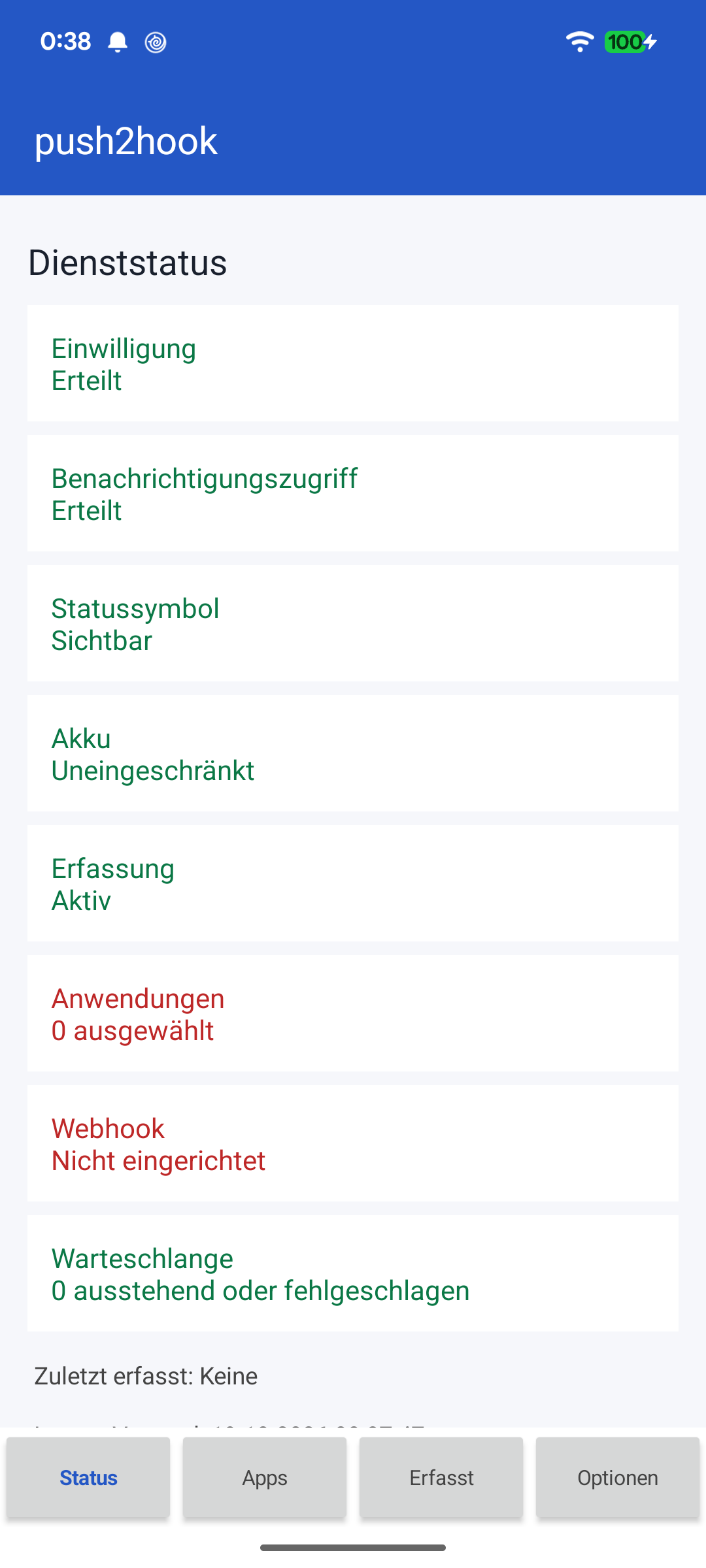
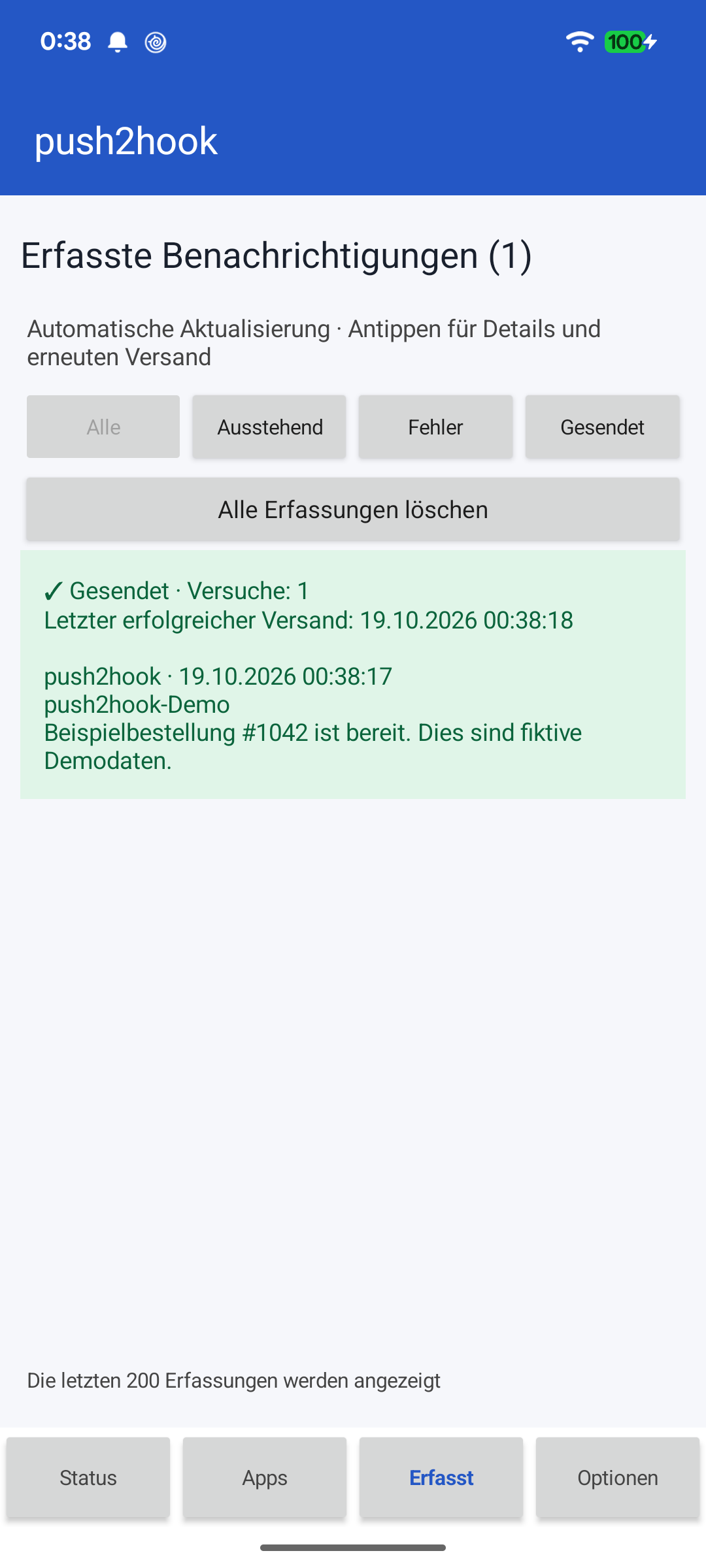
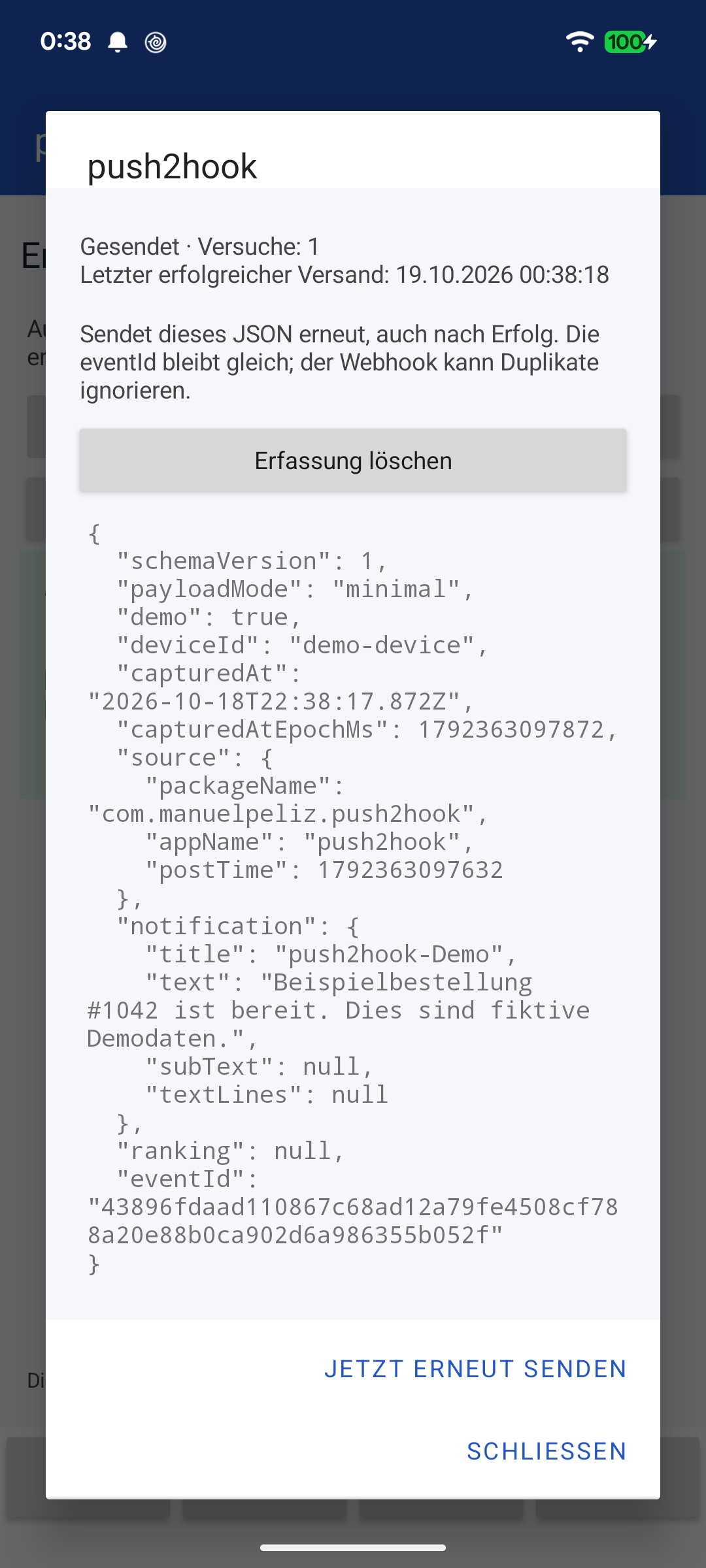
Beispielinhalt: X-Device-Id muss deviceId entsprechen. X-Timestamp ist die aktuelle Unix-Zeit in Sekunden, nicht capturedAt.
POST /webhook HTTP/1.1
Content-Type: application/json; charset=utf-8
X-Device-Id: my-phone
X-Timestamp: <unix-seconds>
X-Signature: <Base64 HMAC-SHA256>{
"schemaVersion": 1,
"payloadMode": "minimal",
"demo": false,
"deviceId": "my-phone",
"eventId": "stable-event-id",
"capturedAt": "2026-10-19T10:30:00Z",
"source": {
"packageName": "com.example.orders",
"appName": "Orders",
"postTime": 1792405800000
},
"notification": {
"title": "Order ready",
"text": "Example order #1042",
"subText": null,
"textLines": null
},
"ranking": null
}X-Signature = Base64(HMAC-SHA256(secret, timestamp + "." + rawBody))
Server-Empfänger ansehenIhr Server empfängt den obigen POST. Node.js, PHP oder Python zum Prüfen und Speichern der Benachrichtigung wählen.
Gesendetes JSON ansehenNode.js 20+, ohne Abhängigkeiten. node receiver.mjs hinter einem HTTPS-Proxy starten; hört nur auf 127.0.0.1:8000 (oder PORT).
// Node.js 20+, standard library only. Run behind an HTTPS reverse proxy:
// node receiver.mjs (listens on 127.0.0.1:8000, or PORT).
// Configure PUSH2HOOK_DEVICE_ID, PUSH2HOOK_SECRET (32+ UTF-8 bytes),
// PUSH2HOOK_INBOX: an existing private directory outside the web root.
import { createServer } from 'node:http';
import { createHash, createHmac, randomUUID, timingSafeEqual } from 'node:crypto';
import * as fs from 'node:fs/promises';
import { isAbsolute, join } from 'node:path';
import { TextDecoder } from 'node:util';

const MAX_BODY = 1048576;
const isObject = value => value !== null && typeof value === 'object' && !Array.isArray(value);

const server = createServer(async (request, response) => {
  const reply = (status, message = '') => {
    request.resume();
    const body = message ? JSON.stringify({ error: message }) : '';
    response.writeHead(status, {
      'Content-Type': 'application/json; charset=utf-8',
      'Cache-Control': 'no-store', 'X-Content-Type-Options': 'nosniff',
      'Content-Length': Buffer.byteLength(body), ...(status === 405 ? { Allow: 'POST' } : {}),
    });
    response.end(body);
  };
  const header = name => typeof request.headers[name] === 'string' ? request.headers[name] : '';
  let temporary;
  try {
    if (request.method !== 'POST') return reply(405, 'POST required');
    if (header('content-type').split(';', 1)[0].trim().toLowerCase() !== 'application/json') {
      return reply(415, 'application/json required');
    }
    const device = process.env.PUSH2HOOK_DEVICE_ID || '';
    const secret = Buffer.from(process.env.PUSH2HOOK_SECRET || '', 'utf8');
    const inbox = process.env.PUSH2HOOK_INBOX || '';
    if (!device || secret.length < 32 || !isAbsolute(inbox) || !(await fs.stat(inbox)).isDirectory()) {
      return reply(503, 'Receiver not configured');
    }
    const timestamp = header('x-timestamp');
    const signature = header('x-signature');
    if (header('x-device-id') !== device || !/^[0-9]{1,12}$/.test(timestamp)
        || Math.abs(Math.floor(Date.now() / 1000) - Number(timestamp)) > 300
        || !/^[A-Za-z0-9+/]{43}=$/.test(signature)) {
      return reply(401, 'Authentication failed');
    }
    const length = header('content-length');
    if (!/^[0-9]{1,10}$/.test(length)) return reply(411, 'Content-Length required');
    if (Number(length) > MAX_BODY) return reply(413, 'Body too large');
    const chunks = [];
    let size = 0;
    for await (const chunk of request) {
      size += chunk.length;
      if (size > MAX_BODY) return reply(413, 'Body too large');
      chunks.push(chunk);
    }
    const raw = Buffer.concat(chunks);
    if (raw.length !== Number(length)) return reply(400, 'Incomplete body');

    // HMAC uses ORIGINAL bytes. Never parse/re-serialize JSON before verification.
    const expected = createHmac('sha256', secret).update(timestamp + '.', 'utf8').update(raw).digest();
    const supplied = Buffer.from(signature, 'base64');
    if (supplied.length !== 32 || !timingSafeEqual(expected, supplied)) {
      return reply(401, 'Authentication failed');
    }
    let data;
    try {
      data = JSON.parse(new TextDecoder('utf-8', { fatal: true }).decode(raw));
    } catch {
      return reply(400, 'Invalid JSON');
    }
    if (!isObject(data) || data.schemaVersion !== 1 || data.deviceId !== device || data.demo !== false
        || typeof data.eventId !== 'string' || data.eventId.length < 1 || data.eventId.length > 200
        || /[^A-Za-z0-9._:-]/.test(data.eventId) || !isObject(data.source)
        || typeof data.source.packageName !== 'string' || !data.source.packageName
        || Buffer.byteLength(data.source.packageName, 'utf8') > 255
        || !isObject(data.notification) || Object.keys(data.notification).length === 0) {
      return reply(400, 'Invalid notification or device mismatch');
    }

    // Publish a complete private inbox file atomically, without overwriting an
    // existing device + eventId. Process these files asynchronously.
    const key = createHash('sha256').update(device + '\0' + data.eventId, 'utf8').digest('hex');
    const target = join(inbox, key + '.json');
    temporary = join(inbox, '.pending-' + randomUUID());
    const output = await fs.open(temporary, 'wx', 0o600);
    try {
      await output.writeFile(raw);
      await output.sync();
    } finally {
      await output.close();
    }
    let duplicate = false;
    try {
      await fs.link(temporary, target);
    } catch (error) {
      if (error.code !== 'EEXIST' || !(await fs.stat(target)).isFile()) throw error;
      duplicate = true;
    }
    reply(duplicate ? 204 : 202);
  } catch {
    // A failed write must return 5xx so push2hook can retry.
    if (!response.headersSent) reply(503, 'Storage unavailable');
  } finally {
    if (temporary) await fs.unlink(temporary).catch(() => {});
  }
});
server.requestTimeout = 15000;
server.headersTimeout = 10000;
server.listen(Number(process.env.PORT || 8000), '127.0.0.1');
PHP 8.1+, ohne zusätzliche Erweiterungen. receiver.php über Ihren HTTPS-Webserver bereitstellen und PHP-FPM-Umgebung konfigurieren.
<?php
declare(strict_types=1);

// PHP 8.1+. Configure these variables in the PHP-FPM process environment.
// PUSH2HOOK_DEVICE_ID, PUSH2HOOK_SECRET (32+ bytes), PUSH2HOOK_INBOX.
// Serve behind HTTPS. The inbox directory must be private and outside the web root.
header('Content-Type: application/json; charset=utf-8');
header('Cache-Control: no-store');
header('X-Content-Type-Options: nosniff');

function reply(int $status, string $message = ''): never {
    http_response_code($status);
    if ($message !== '') echo json_encode(['error' => $message]);
    exit;
}

if (($_SERVER['REQUEST_METHOD'] ?? '') !== 'POST') {
    header('Allow: POST');
    reply(405, 'POST required');
}
if (strtolower(trim(explode(';', $_SERVER['CONTENT_TYPE'] ?? '')[0])) !== 'application/json') {
    reply(415, 'application/json required');
}

$device = getenv('PUSH2HOOK_DEVICE_ID') ?: '';
$secret = getenv('PUSH2HOOK_SECRET') ?: '';
$inbox = getenv('PUSH2HOOK_INBOX') ?: '';
if ($device === '' || strlen($secret) < 32 || $inbox === '' || $inbox[0] !== '/' || !is_dir($inbox)) {
    reply(503, 'Receiver not configured');
}

$deviceHeader = $_SERVER['HTTP_X_DEVICE_ID'] ?? '';
$timestamp = $_SERVER['HTTP_X_TIMESTAMP'] ?? '';
$signature = $_SERVER['HTTP_X_SIGNATURE'] ?? '';
$now = time();
if (!hash_equals($device, $deviceHeader) || !preg_match('/\A[0-9]{1,12}\z/', $timestamp) ||
    abs($now - (int)$timestamp) > 300 || strlen($signature) > 128) {
    reply(401, 'Authentication failed');
}

const MAX_BODY = 1048576;
if ((int)($_SERVER['CONTENT_LENGTH'] ?? 0) > MAX_BODY) reply(413, 'Body too large');
$raw = file_get_contents('php://input', false, null, 0, MAX_BODY + 1);
if ($raw === false || strlen($raw) > MAX_BODY) reply(413, 'Body too large');

// Sign the ORIGINAL bytes: never decode/re-encode JSON before checking HMAC.
// Base64(HMAC-SHA256(UTF8(secret), UTF8(timestamp + ".") + rawBody)).
$supplied = base64_decode($signature, true);
$expected = hash_hmac('sha256', $timestamp . '.' . $raw, $secret, true);
if ($supplied === false || strlen($supplied) !== 32 || !hash_equals($expected, $supplied)) {
    reply(401, 'Authentication failed');
}

try {
    $data = json_decode($raw, true, 64, JSON_THROW_ON_ERROR);
} catch (JsonException $error) {
    reply(400, 'Invalid JSON');
}
if (!is_array($data) || ($data['schemaVersion'] ?? null) !== 1 ||
    ($data['deviceId'] ?? null) !== $device || ($data['demo'] ?? null) !== false ||
    !is_string($data['eventId'] ?? null) ||
    !preg_match('/\A[A-Za-z0-9._:-]{1,200}\z/', $data['eventId']) ||
    !is_array($data['source'] ?? null) || !is_string($data['source']['packageName'] ?? null) ||
    $data['source']['packageName'] === '' || strlen($data['source']['packageName']) > 255 ||
    !is_array($data['notification'] ?? null) || array_is_list($data['notification'])) {
    reply(400, 'Invalid notification or device mismatch');
}

// A persistent inbox, keyed by device + eventId. Retries are acknowledged without
// storing a second copy. Process these files asynchronously in your automation.
$path = $inbox . '/' . hash('sha256', $device . "\0" . $data['eventId']) . '.json';
$temporary = null;
$lock = null;
$output = null;
$duplicate = false;
$oldMask = umask(0077);
try {
    $lock = @fopen($inbox . '/.lock', 'c');
    if ($lock === false || !flock($lock, LOCK_EX)) throw new RuntimeException();
    $duplicate = is_file($path);
    if (!$duplicate) {
        $temporary = tempnam($inbox, '.pending-');
        if ($temporary === false) throw new RuntimeException();
        $output = fopen($temporary, 'wb');
        if ($output === false) throw new RuntimeException();
        $offset = 0;
        while ($offset < strlen($raw)) {
            $written = fwrite($output, substr($raw, $offset));
            if ($written === false || $written === 0) throw new RuntimeException();
            $offset += $written;
        }
        if (!fflush($output) || !fsync($output)) throw new RuntimeException();
        fclose($output);
        $output = null;
        if (!rename($temporary, $path)) throw new RuntimeException();
        $temporary = null;
    }
} catch (Throwable $error) {
    // A 5xx response asks push2hook to retry; never acknowledge failed storage.
    $failed = true;
} finally {
    if (is_resource($output)) fclose($output);
    if (is_string($temporary) && is_file($temporary)) unlink($temporary);
    if (is_resource($lock)) { flock($lock, LOCK_UN); fclose($lock); }
    umask($oldMask);
}
if (isset($failed)) reply(503, 'Storage unavailable');
reply($duplicate ? 204 : 202);
Python 3.10+, Linux/macOS. application über einen produktiven WSGI-Server hinter HTTPS bereitstellen. python3 receiver.py dient nur lokaler Entwicklung.
"""Python 3.10+, Linux/macOS. Expose application through a WSGI server + HTTPS.

Configure PUSH2HOOK_DEVICE_ID, PUSH2HOOK_SECRET (32+ UTF-8 bytes), PUSH2HOOK_INBOX.
The inbox must be an existing private directory, outside your web root.
python3 receiver.py starts a loopback-only DEVELOPMENT server, port 8000.
"""
import base64
import binascii
import fcntl
import hashlib
import hmac
import json
import os
from pathlib import Path
import re
import tempfile
import time
from http import HTTPStatus

MAX_BODY = 1048576


def application(environ, start_response):
    def reply(status, message=""):
        body = json.dumps({"error": message}).encode() if message else b""
        headers = [("Content-Type", "application/json; charset=utf-8"),
                   ("Cache-Control", "no-store"), ("X-Content-Type-Options", "nosniff"),
                   ("Content-Length", str(len(body)))]
        if status == 405:
            headers.append(("Allow", "POST"))
        start_response(f"{status} {HTTPStatus(status).phrase}", headers)
        return [body]

    if environ.get("REQUEST_METHOD") != "POST":
        return reply(405, "POST required")
    if environ.get("CONTENT_TYPE", "").split(";", 1)[0].strip().lower() != "application/json":
        return reply(415, "application/json required")

    device = os.environ.get("PUSH2HOOK_DEVICE_ID", "")
    secret = os.environ.get("PUSH2HOOK_SECRET", "").encode("utf-8")
    inbox = Path(os.environ.get("PUSH2HOOK_INBOX", "."))
    if not device or len(secret) < 32 or not inbox.is_absolute() or not inbox.is_dir():
        return reply(503, "Receiver not configured")

    device_header = environ.get("HTTP_X_DEVICE_ID", "")
    timestamp = environ.get("HTTP_X_TIMESTAMP", "")
    signature = environ.get("HTTP_X_SIGNATURE", "")
    now = int(time.time())
    if (not hmac.compare_digest(device.encode("utf-8"), device_header.encode("utf-8"))
            or not re.fullmatch(r"[0-9]{1,12}", timestamp)
            or abs(now - int(timestamp)) > 300 or len(signature) > 128):
        return reply(401, "Authentication failed")

    length = environ.get("CONTENT_LENGTH", "")
    if not re.fullmatch(r"[0-9]{1,10}", length):
        return reply(411, "Content-Length required")
    length = int(length)
    if length > MAX_BODY:
        return reply(413, "Body too large")
    raw = environ["wsgi.input"].read(length)
    if len(raw) != length:
        return reply(400, "Incomplete body")

    # Verify ORIGINAL bytes; do not decode/re-encode JSON before checking HMAC.
    expected = hmac.digest(secret, timestamp.encode("ascii") + b"." + raw, "sha256")
    try:
        supplied = base64.b64decode(signature, validate=True)
    except (ValueError, binascii.Error):
        return reply(401, "Authentication failed")
    if len(supplied) != 32 or not hmac.compare_digest(expected, supplied):
        return reply(401, "Authentication failed")

    try:
        data = json.loads(raw.decode("utf-8"))
    except (ValueError, UnicodeError, RecursionError):
        return reply(400, "Invalid JSON")
    if (not isinstance(data, dict) or type(data.get("schemaVersion")) is not int
            or data["schemaVersion"] != 1 or data.get("deviceId") != device
            or data.get("demo") is not False or not isinstance(data.get("eventId"), str)
            or not re.fullmatch(r"[A-Za-z0-9._:-]{1,200}", data["eventId"])
            or not isinstance(data.get("source"), dict)
            or not isinstance(data["source"].get("packageName"), str)
            or not 1 <= len(data["source"]["packageName"].encode("utf-8")) <= 255
            or not isinstance(data.get("notification"), dict) or not data["notification"]):
        return reply(400, "Invalid notification or device mismatch")

    # Stable inbox key: acknowledge retries, but never store a second copy.
    key = hashlib.sha256((device + "\0" + data["eventId"]).encode("utf-8")).hexdigest()
    target = inbox / f"{key}.json"
    temporary = None
    try:
        descriptor = os.open(inbox / ".lock", os.O_CREAT | os.O_WRONLY, 0o600)
        with os.fdopen(descriptor, "wb") as lock:
            fcntl.flock(lock, fcntl.LOCK_EX)
            duplicate = target.is_file()
            if not duplicate:
                descriptor, temporary = tempfile.mkstemp(prefix=".pending-", dir=inbox)
                with os.fdopen(descriptor, "wb") as output:
                    output.write(raw)
                    output.flush()
                    os.fsync(output.fileno())
                os.replace(temporary, target)
                temporary = None
    except OSError:
        # 5xx asks push2hook to retry. A failed write must never return success.
        return reply(503, "Storage unavailable")
    finally:
        if temporary is not None:
            Path(temporary).unlink(missing_ok=True)
    return reply(204 if duplicate else 202)


if __name__ == "__main__":
    from wsgiref.simple_server import make_server
    with make_server("127.0.0.1", int(os.environ.get("PORT", "8000")), application) as server:
        server.serve_forever()
In der App Ihre HTTPS-URL, die Gerätekennung my-phone und einen zufälligen HMAC-Schlüssel mit mindestens 32 Zeichen eintragen. Dieselben Werte im Serverprozess verwenden, je Gerät einen eigenen Schlüssel. Dies ist nicht der Android-Signaturschlüssel.
Servervariablen (Schlüssel ersetzen; privates Verzeichnis außerhalb des Webverzeichnisses mit Schreibrecht für den Empfänger erstellen):
PUSH2HOOK_DEVICE_ID=my-phone
PUSH2HOOK_SECRET='PASTE_YOUR_RANDOM_SECRET_HERE'
PUSH2HOOK_INBOX=/var/lib/push2hook/inbox
Prüfung: POST und JSON, konfiguriertes Gerät, Zeitstempel innerhalb ±5 Minuten, Base64-HMAC-SHA256 über Originalbytes, zeitkonstanter Signaturvergleich, übereinstimmende JSON-deviceId, Schema und eventId. Telefon- und Serveruhr synchronisieren.
Gültige Ereignisse werden als private JSON-Dateien gespeichert und mit 202 bestätigt. Diese Dateien verarbeitet Ihre Automatisierung. Atomare Dateiveröffentlichung vermeidet doppelte Speicherung; dasselbe Gerät und eventId erhalten 204. Dateilöschung entfernt auch den Duplikatschutz. Eigene Aufbewahrung festlegen und Verzeichnis schützen.
Die App akzeptiert 2xx, wiederholt Netzwerkfehler und 5xx (auch 408/429) und markiert andere 4xx als fehlgeschlagen. Manuelles Wiederholen behält eventId: bestehende Ereignisse werden bestätigt, aber nicht erneut verarbeitet. Benachrichtigungstext niemals als Code oder Shell-Befehl ausführen.
Sechs Sprachen gemäß Ihrem Telefon: Englisch, Spanisch, Französisch, Deutsch, Portugiesisch und Italienisch. Auch in den Android-Einstellungen auswählbar.
Echte Daten gehen an Ihre eingerichteten HTTPS-Ziele. Die optionale Demo sendet nur ein fiktives Beispiel an manuelpeliz.es mit einer festen Demokennung.
Beim Verlassen bleibt die Erfassung aktiv. Berechtigungen, Netzwerk, Akku und Gerätevorgaben beeinflussen die Übertragung. Stopp erzwingen in Android beendet die App.
Ja. EventId und JSON bleiben erhalten. Ihr Webhook kann diese Kennung deduplizieren.
Sie automatisiert eigene Benachrichtigungen und ist nicht für heimliche Überwachung anderer Menschen vorgesehen.