Scegli i dati inviati
Nessuna app viene selezionata automaticamente. Scegli app, parole facoltative e destinazioni.
 Push Notifications to Webhook
Android · HTTPS · Webhooks
Inoltra le notifiche delle app Android scelte ai tuoi webhook HTTPS. Filtra per parole, segui gli invii e mantieni il controllo.
Android 12+ · Pubblicazione in preparazioneNessuna app viene selezionata automaticamente. Scegli app, parole facoltative e destinazioni.
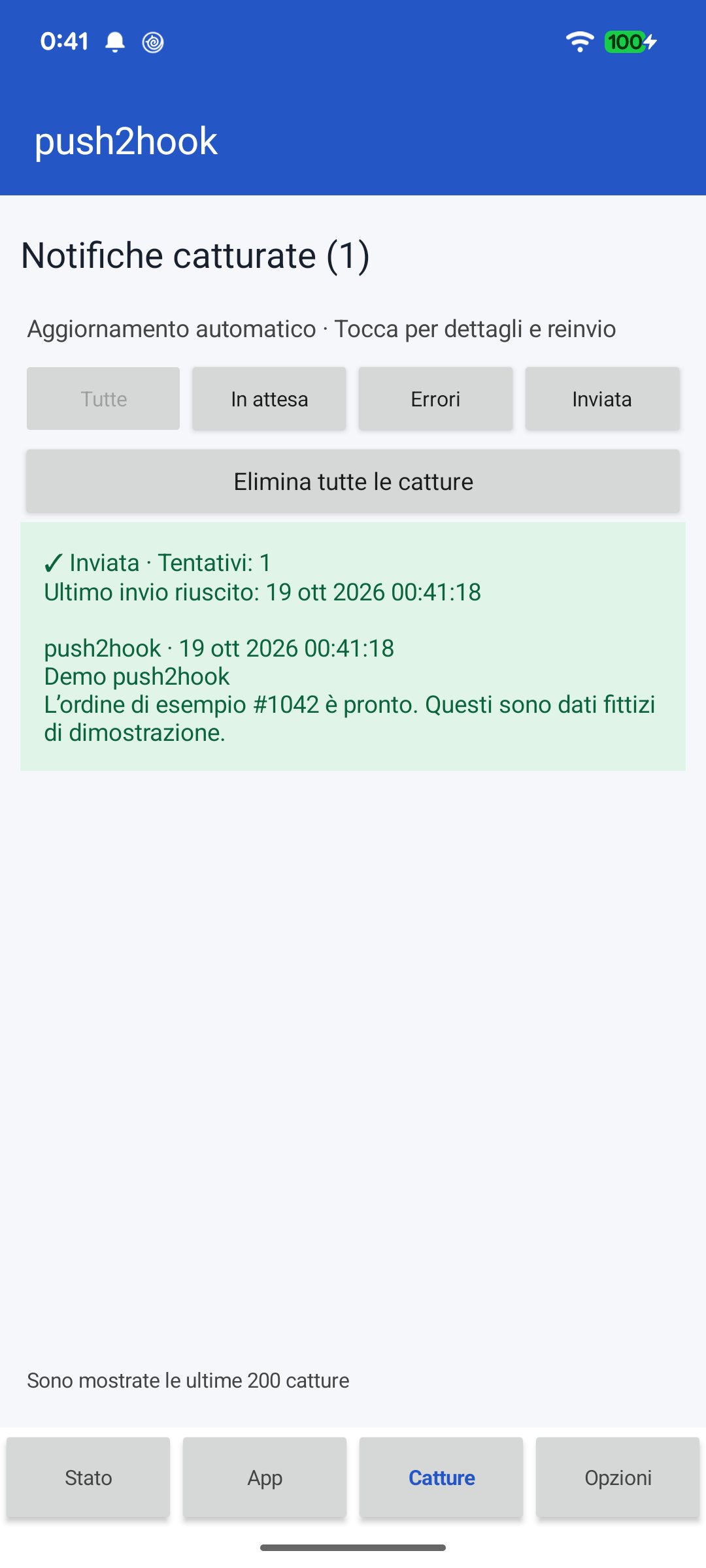
La cronologia mostra attesa, invio, consegna ed errori. Puoi reinviare anche una notifica già consegnata.
La cattura continua uscendo dalla schermata. Chiudi e arresta ferma cattura e invii fino alla prossima apertura.
HTTPS, firma HMAC-SHA256 facoltativa, solo Wi-Fi e conservazione locale configurabile.
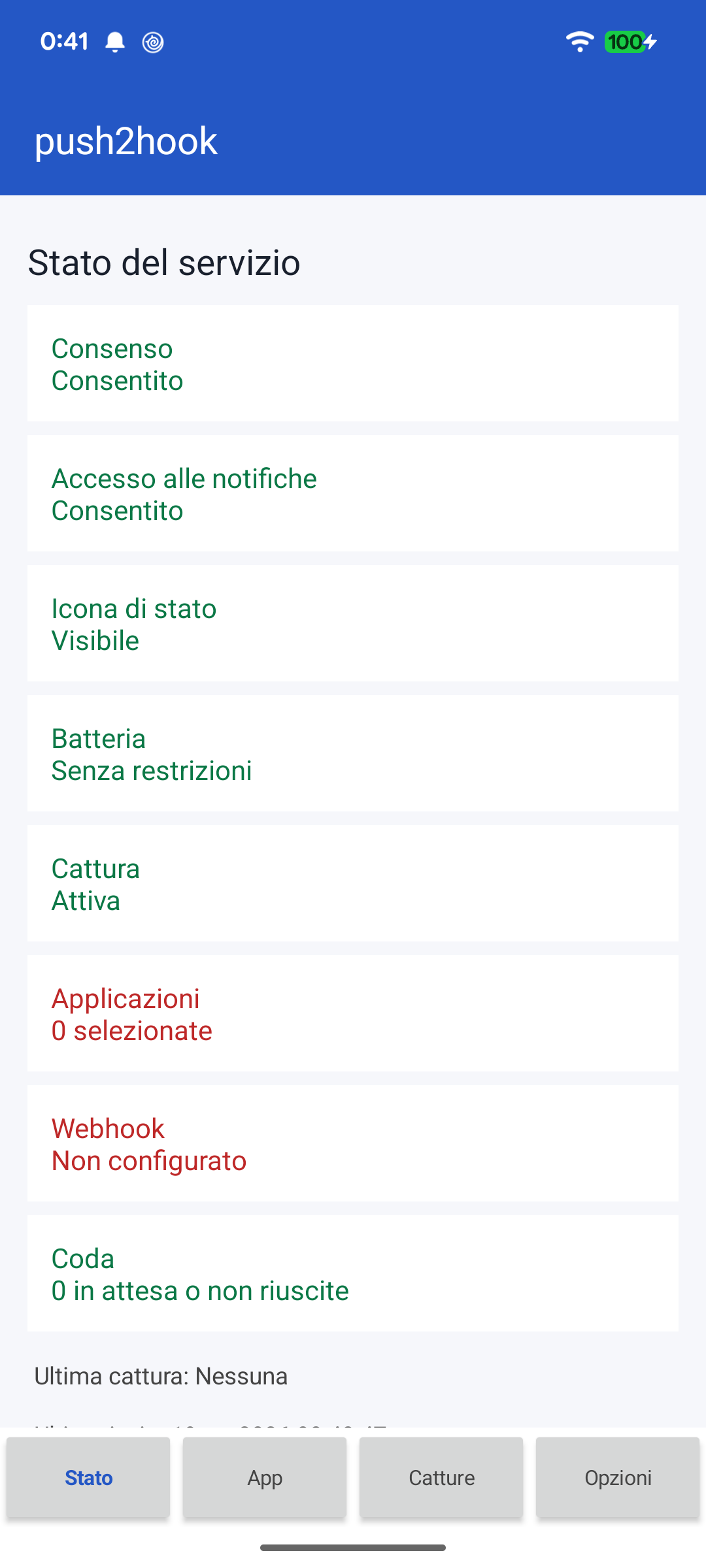
Leggi le informazioni e accetta per attivare la cattura. Puoi revocare il consenso nelle Impostazioni.
Android richiede un permesso separato. Controlla l’avviso di stato e le restrizioni della batteria.
Inserisci un URL HTTPS nelle Impostazioni, poi scegli app e parole. Ogni app può avere il proprio URL.
Catture mostra stato, tentativi e JSON. Prova la demo fittizia prima della tua integrazione.
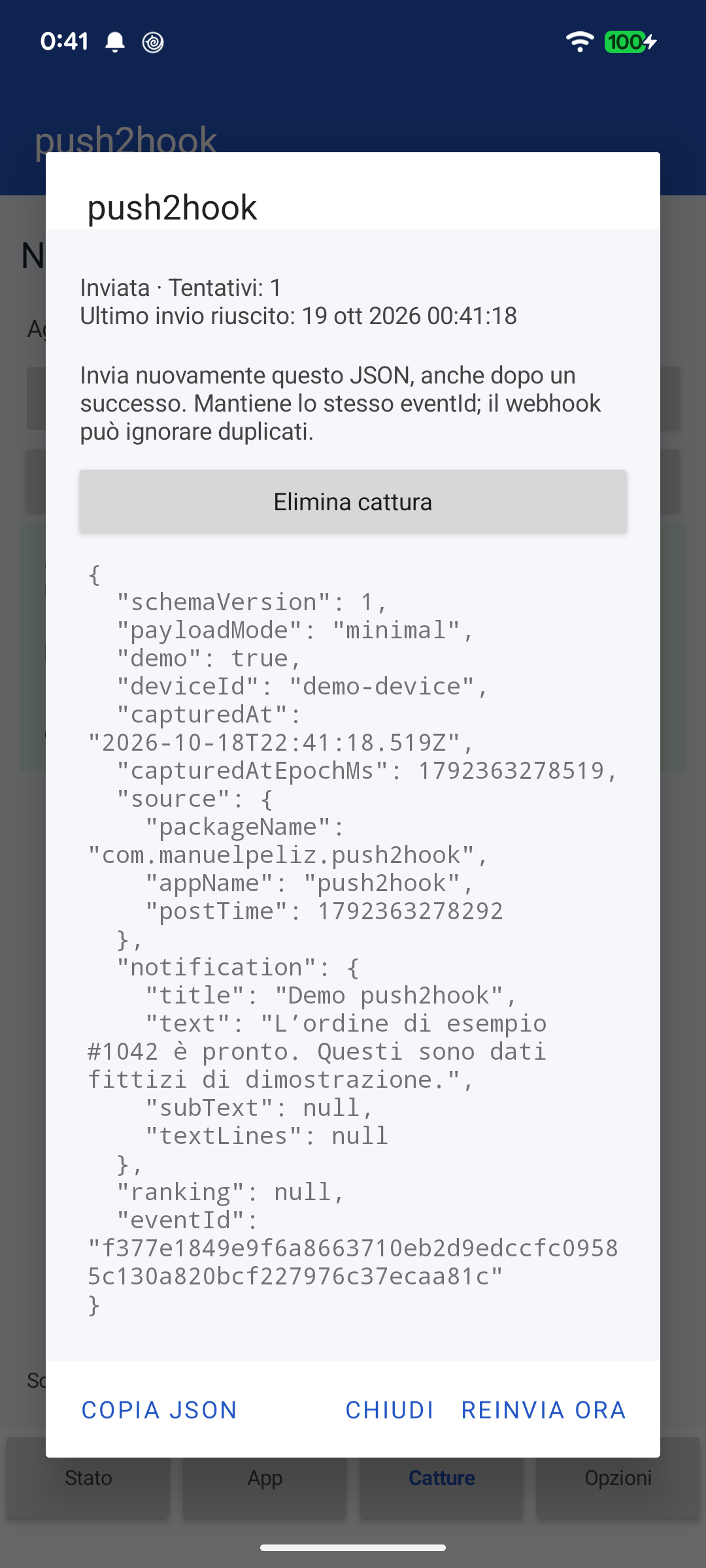
Corpo di esempio: X-Device-Id deve corrispondere a deviceId. X-Timestamp è l’ora Unix attuale in secondi, non capturedAt.
POST /webhook HTTP/1.1
Content-Type: application/json; charset=utf-8
X-Device-Id: my-phone
X-Timestamp: <unix-seconds>
X-Signature: <Base64 HMAC-SHA256>{
"schemaVersion": 1,
"payloadMode": "minimal",
"demo": false,
"deviceId": "my-phone",
"eventId": "stable-event-id",
"capturedAt": "2026-10-19T10:30:00Z",
"source": {
"packageName": "com.example.orders",
"appName": "Orders",
"postTime": 1792405800000
},
"notification": {
"title": "Order ready",
"text": "Example order #1042",
"subText": null,
"textLines": null
},
"ranking": null
}X-Signature = Base64(HMAC-SHA256(secret, timestamp + "." + rawBody))
Vedi ricevitore serverIl server riceve il POST qui sopra. Scegli Node.js, PHP o Python per verificare e salvare la notifica.
Vedi JSON inviatoNode.js 20+, senza dipendenze. Esegui node receiver.mjs dietro un proxy HTTPS; ascolta solo su 127.0.0.1:8000 (o PORT).
// Node.js 20+, standard library only. Run behind an HTTPS reverse proxy:
// node receiver.mjs (listens on 127.0.0.1:8000, or PORT).
// Configure PUSH2HOOK_DEVICE_ID, PUSH2HOOK_SECRET (32+ UTF-8 bytes),
// PUSH2HOOK_INBOX: an existing private directory outside the web root.
import { createServer } from 'node:http';
import { createHash, createHmac, randomUUID, timingSafeEqual } from 'node:crypto';
import * as fs from 'node:fs/promises';
import { isAbsolute, join } from 'node:path';
import { TextDecoder } from 'node:util';

const MAX_BODY = 1048576;
const isObject = value => value !== null && typeof value === 'object' && !Array.isArray(value);

const server = createServer(async (request, response) => {
  const reply = (status, message = '') => {
    request.resume();
    const body = message ? JSON.stringify({ error: message }) : '';
    response.writeHead(status, {
      'Content-Type': 'application/json; charset=utf-8',
      'Cache-Control': 'no-store', 'X-Content-Type-Options': 'nosniff',
      'Content-Length': Buffer.byteLength(body), ...(status === 405 ? { Allow: 'POST' } : {}),
    });
    response.end(body);
  };
  const header = name => typeof request.headers[name] === 'string' ? request.headers[name] : '';
  let temporary;
  try {
    if (request.method !== 'POST') return reply(405, 'POST required');
    if (header('content-type').split(';', 1)[0].trim().toLowerCase() !== 'application/json') {
      return reply(415, 'application/json required');
    }
    const device = process.env.PUSH2HOOK_DEVICE_ID || '';
    const secret = Buffer.from(process.env.PUSH2HOOK_SECRET || '', 'utf8');
    const inbox = process.env.PUSH2HOOK_INBOX || '';
    if (!device || secret.length < 32 || !isAbsolute(inbox) || !(await fs.stat(inbox)).isDirectory()) {
      return reply(503, 'Receiver not configured');
    }
    const timestamp = header('x-timestamp');
    const signature = header('x-signature');
    if (header('x-device-id') !== device || !/^[0-9]{1,12}$/.test(timestamp)
        || Math.abs(Math.floor(Date.now() / 1000) - Number(timestamp)) > 300
        || !/^[A-Za-z0-9+/]{43}=$/.test(signature)) {
      return reply(401, 'Authentication failed');
    }
    const length = header('content-length');
    if (!/^[0-9]{1,10}$/.test(length)) return reply(411, 'Content-Length required');
    if (Number(length) > MAX_BODY) return reply(413, 'Body too large');
    const chunks = [];
    let size = 0;
    for await (const chunk of request) {
      size += chunk.length;
      if (size > MAX_BODY) return reply(413, 'Body too large');
      chunks.push(chunk);
    }
    const raw = Buffer.concat(chunks);
    if (raw.length !== Number(length)) return reply(400, 'Incomplete body');

    // HMAC uses ORIGINAL bytes. Never parse/re-serialize JSON before verification.
    const expected = createHmac('sha256', secret).update(timestamp + '.', 'utf8').update(raw).digest();
    const supplied = Buffer.from(signature, 'base64');
    if (supplied.length !== 32 || !timingSafeEqual(expected, supplied)) {
      return reply(401, 'Authentication failed');
    }
    let data;
    try {
      data = JSON.parse(new TextDecoder('utf-8', { fatal: true }).decode(raw));
    } catch {
      return reply(400, 'Invalid JSON');
    }
    if (!isObject(data) || data.schemaVersion !== 1 || data.deviceId !== device || data.demo !== false
        || typeof data.eventId !== 'string' || data.eventId.length < 1 || data.eventId.length > 200
        || /[^A-Za-z0-9._:-]/.test(data.eventId) || !isObject(data.source)
        || typeof data.source.packageName !== 'string' || !data.source.packageName
        || Buffer.byteLength(data.source.packageName, 'utf8') > 255
        || !isObject(data.notification) || Object.keys(data.notification).length === 0) {
      return reply(400, 'Invalid notification or device mismatch');
    }

    // Publish a complete private inbox file atomically, without overwriting an
    // existing device + eventId. Process these files asynchronously.
    const key = createHash('sha256').update(device + '\0' + data.eventId, 'utf8').digest('hex');
    const target = join(inbox, key + '.json');
    temporary = join(inbox, '.pending-' + randomUUID());
    const output = await fs.open(temporary, 'wx', 0o600);
    try {
      await output.writeFile(raw);
      await output.sync();
    } finally {
      await output.close();
    }
    let duplicate = false;
    try {
      await fs.link(temporary, target);
    } catch (error) {
      if (error.code !== 'EEXIST' || !(await fs.stat(target)).isFile()) throw error;
      duplicate = true;
    }
    reply(duplicate ? 204 : 202);
  } catch {
    // A failed write must return 5xx so push2hook can retry.
    if (!response.headersSent) reply(503, 'Storage unavailable');
  } finally {
    if (temporary) await fs.unlink(temporary).catch(() => {});
  }
});
server.requestTimeout = 15000;
server.headersTimeout = 10000;
server.listen(Number(process.env.PORT || 8000), '127.0.0.1');
PHP 8.1+, senza estensioni aggiuntive. Servi receiver.php tramite il server HTTPS e configura le variabili PHP-FPM.
<?php
declare(strict_types=1);

// PHP 8.1+. Configure these variables in the PHP-FPM process environment.
// PUSH2HOOK_DEVICE_ID, PUSH2HOOK_SECRET (32+ bytes), PUSH2HOOK_INBOX.
// Serve behind HTTPS. The inbox directory must be private and outside the web root.
header('Content-Type: application/json; charset=utf-8');
header('Cache-Control: no-store');
header('X-Content-Type-Options: nosniff');

function reply(int $status, string $message = ''): never {
    http_response_code($status);
    if ($message !== '') echo json_encode(['error' => $message]);
    exit;
}

if (($_SERVER['REQUEST_METHOD'] ?? '') !== 'POST') {
    header('Allow: POST');
    reply(405, 'POST required');
}
if (strtolower(trim(explode(';', $_SERVER['CONTENT_TYPE'] ?? '')[0])) !== 'application/json') {
    reply(415, 'application/json required');
}

$device = getenv('PUSH2HOOK_DEVICE_ID') ?: '';
$secret = getenv('PUSH2HOOK_SECRET') ?: '';
$inbox = getenv('PUSH2HOOK_INBOX') ?: '';
if ($device === '' || strlen($secret) < 32 || $inbox === '' || $inbox[0] !== '/' || !is_dir($inbox)) {
    reply(503, 'Receiver not configured');
}

$deviceHeader = $_SERVER['HTTP_X_DEVICE_ID'] ?? '';
$timestamp = $_SERVER['HTTP_X_TIMESTAMP'] ?? '';
$signature = $_SERVER['HTTP_X_SIGNATURE'] ?? '';
$now = time();
if (!hash_equals($device, $deviceHeader) || !preg_match('/\A[0-9]{1,12}\z/', $timestamp) ||
    abs($now - (int)$timestamp) > 300 || strlen($signature) > 128) {
    reply(401, 'Authentication failed');
}

const MAX_BODY = 1048576;
if ((int)($_SERVER['CONTENT_LENGTH'] ?? 0) > MAX_BODY) reply(413, 'Body too large');
$raw = file_get_contents('php://input', false, null, 0, MAX_BODY + 1);
if ($raw === false || strlen($raw) > MAX_BODY) reply(413, 'Body too large');

// Sign the ORIGINAL bytes: never decode/re-encode JSON before checking HMAC.
// Base64(HMAC-SHA256(UTF8(secret), UTF8(timestamp + ".") + rawBody)).
$supplied = base64_decode($signature, true);
$expected = hash_hmac('sha256', $timestamp . '.' . $raw, $secret, true);
if ($supplied === false || strlen($supplied) !== 32 || !hash_equals($expected, $supplied)) {
    reply(401, 'Authentication failed');
}

try {
    $data = json_decode($raw, true, 64, JSON_THROW_ON_ERROR);
} catch (JsonException $error) {
    reply(400, 'Invalid JSON');
}
if (!is_array($data) || ($data['schemaVersion'] ?? null) !== 1 ||
    ($data['deviceId'] ?? null) !== $device || ($data['demo'] ?? null) !== false ||
    !is_string($data['eventId'] ?? null) ||
    !preg_match('/\A[A-Za-z0-9._:-]{1,200}\z/', $data['eventId']) ||
    !is_array($data['source'] ?? null) || !is_string($data['source']['packageName'] ?? null) ||
    $data['source']['packageName'] === '' || strlen($data['source']['packageName']) > 255 ||
    !is_array($data['notification'] ?? null) || array_is_list($data['notification'])) {
    reply(400, 'Invalid notification or device mismatch');
}

// A persistent inbox, keyed by device + eventId. Retries are acknowledged without
// storing a second copy. Process these files asynchronously in your automation.
$path = $inbox . '/' . hash('sha256', $device . "\0" . $data['eventId']) . '.json';
$temporary = null;
$lock = null;
$output = null;
$duplicate = false;
$oldMask = umask(0077);
try {
    $lock = @fopen($inbox . '/.lock', 'c');
    if ($lock === false || !flock($lock, LOCK_EX)) throw new RuntimeException();
    $duplicate = is_file($path);
    if (!$duplicate) {
        $temporary = tempnam($inbox, '.pending-');
        if ($temporary === false) throw new RuntimeException();
        $output = fopen($temporary, 'wb');
        if ($output === false) throw new RuntimeException();
        $offset = 0;
        while ($offset < strlen($raw)) {
            $written = fwrite($output, substr($raw, $offset));
            if ($written === false || $written === 0) throw new RuntimeException();
            $offset += $written;
        }
        if (!fflush($output) || !fsync($output)) throw new RuntimeException();
        fclose($output);
        $output = null;
        if (!rename($temporary, $path)) throw new RuntimeException();
        $temporary = null;
    }
} catch (Throwable $error) {
    // A 5xx response asks push2hook to retry; never acknowledge failed storage.
    $failed = true;
} finally {
    if (is_resource($output)) fclose($output);
    if (is_string($temporary) && is_file($temporary)) unlink($temporary);
    if (is_resource($lock)) { flock($lock, LOCK_UN); fclose($lock); }
    umask($oldMask);
}
if (isset($failed)) reply(503, 'Storage unavailable');
reply($duplicate ? 204 : 202);
Python 3.10+, Linux/macOS. Pubblica application tramite un server WSGI di produzione dietro HTTPS. python3 receiver.py è solo per sviluppo locale.
"""Python 3.10+, Linux/macOS. Expose application through a WSGI server + HTTPS.

Configure PUSH2HOOK_DEVICE_ID, PUSH2HOOK_SECRET (32+ UTF-8 bytes), PUSH2HOOK_INBOX.
The inbox must be an existing private directory, outside your web root.
python3 receiver.py starts a loopback-only DEVELOPMENT server, port 8000.
"""
import base64
import binascii
import fcntl
import hashlib
import hmac
import json
import os
from pathlib import Path
import re
import tempfile
import time
from http import HTTPStatus

MAX_BODY = 1048576


def application(environ, start_response):
    def reply(status, message=""):
        body = json.dumps({"error": message}).encode() if message else b""
        headers = [("Content-Type", "application/json; charset=utf-8"),
                   ("Cache-Control", "no-store"), ("X-Content-Type-Options", "nosniff"),
                   ("Content-Length", str(len(body)))]
        if status == 405:
            headers.append(("Allow", "POST"))
        start_response(f"{status} {HTTPStatus(status).phrase}", headers)
        return [body]

    if environ.get("REQUEST_METHOD") != "POST":
        return reply(405, "POST required")
    if environ.get("CONTENT_TYPE", "").split(";", 1)[0].strip().lower() != "application/json":
        return reply(415, "application/json required")

    device = os.environ.get("PUSH2HOOK_DEVICE_ID", "")
    secret = os.environ.get("PUSH2HOOK_SECRET", "").encode("utf-8")
    inbox = Path(os.environ.get("PUSH2HOOK_INBOX", "."))
    if not device or len(secret) < 32 or not inbox.is_absolute() or not inbox.is_dir():
        return reply(503, "Receiver not configured")

    device_header = environ.get("HTTP_X_DEVICE_ID", "")
    timestamp = environ.get("HTTP_X_TIMESTAMP", "")
    signature = environ.get("HTTP_X_SIGNATURE", "")
    now = int(time.time())
    if (not hmac.compare_digest(device.encode("utf-8"), device_header.encode("utf-8"))
            or not re.fullmatch(r"[0-9]{1,12}", timestamp)
            or abs(now - int(timestamp)) > 300 or len(signature) > 128):
        return reply(401, "Authentication failed")

    length = environ.get("CONTENT_LENGTH", "")
    if not re.fullmatch(r"[0-9]{1,10}", length):
        return reply(411, "Content-Length required")
    length = int(length)
    if length > MAX_BODY:
        return reply(413, "Body too large")
    raw = environ["wsgi.input"].read(length)
    if len(raw) != length:
        return reply(400, "Incomplete body")

    # Verify ORIGINAL bytes; do not decode/re-encode JSON before checking HMAC.
    expected = hmac.digest(secret, timestamp.encode("ascii") + b"." + raw, "sha256")
    try:
        supplied = base64.b64decode(signature, validate=True)
    except (ValueError, binascii.Error):
        return reply(401, "Authentication failed")
    if len(supplied) != 32 or not hmac.compare_digest(expected, supplied):
        return reply(401, "Authentication failed")

    try:
        data = json.loads(raw.decode("utf-8"))
    except (ValueError, UnicodeError, RecursionError):
        return reply(400, "Invalid JSON")
    if (not isinstance(data, dict) or type(data.get("schemaVersion")) is not int
            or data["schemaVersion"] != 1 or data.get("deviceId") != device
            or data.get("demo") is not False or not isinstance(data.get("eventId"), str)
            or not re.fullmatch(r"[A-Za-z0-9._:-]{1,200}", data["eventId"])
            or not isinstance(data.get("source"), dict)
            or not isinstance(data["source"].get("packageName"), str)
            or not 1 <= len(data["source"]["packageName"].encode("utf-8")) <= 255
            or not isinstance(data.get("notification"), dict) or not data["notification"]):
        return reply(400, "Invalid notification or device mismatch")

    # Stable inbox key: acknowledge retries, but never store a second copy.
    key = hashlib.sha256((device + "\0" + data["eventId"]).encode("utf-8")).hexdigest()
    target = inbox / f"{key}.json"
    temporary = None
    try:
        descriptor = os.open(inbox / ".lock", os.O_CREAT | os.O_WRONLY, 0o600)
        with os.fdopen(descriptor, "wb") as lock:
            fcntl.flock(lock, fcntl.LOCK_EX)
            duplicate = target.is_file()
            if not duplicate:
                descriptor, temporary = tempfile.mkstemp(prefix=".pending-", dir=inbox)
                with os.fdopen(descriptor, "wb") as output:
                    output.write(raw)
                    output.flush()
                    os.fsync(output.fileno())
                os.replace(temporary, target)
                temporary = None
    except OSError:
        # 5xx asks push2hook to retry. A failed write must never return success.
        return reply(503, "Storage unavailable")
    finally:
        if temporary is not None:
            Path(temporary).unlink(missing_ok=True)
    return reply(204 if duplicate else 202)


if __name__ == "__main__":
    from wsgiref.simple_server import make_server
    with make_server("127.0.0.1", int(os.environ.get("PORT", "8000")), application) as server:
        server.serve_forever()
Nell’app configura il tuo URL HTTPS, il dispositivo my-phone e un segreto HMAC casuale di almeno 32 caratteri. Usa gli stessi valori nel processo server e un segreto diverso per dispositivo. Non è la chiave di firma Android.
Variabili del server (sostituisci il segreto e crea una cartella privata fuori dalla radice web, scrivibile dal ricevitore):
PUSH2HOOK_DEVICE_ID=my-phone
PUSH2HOOK_SECRET='PASTE_YOUR_RANDOM_SECRET_HERE'
PUSH2HOOK_INBOX=/var/lib/push2hook/inbox
Verifiche: POST e JSON, dispositivo configurato, data entro ±5 minuti, HMAC-SHA256 Base64 sui byte originali, confronto a tempo costante, deviceId JSON corrispondente, schema ed eventId. Sincronizza gli orologi di telefono e server.
Un evento valido viene salvato in un file JSON privato e restituisce 202. La tua automazione elabora questi file. La pubblicazione atomica dei file evita duplicati; stesso dispositivo ed eventId restituiscono 204. Eliminare il file elimina anche la deduplicazione. Applica la tua conservazione e proteggi la cartella.
L’app accetta 2xx, riprova errori di rete e 5xx (anche 408/429) e segna gli altri 4xx come falliti. Il reinvio manuale mantiene eventId: un evento esistente viene confermato senza rielaborarlo. Non eseguire mai il testo delle notifiche come codice o comandi.
Sei lingue secondo il telefono: inglese, spagnolo, francese, tedesco, portoghese e italiano. Puoi anche scegliere la lingua dell’app nelle impostazioni Android.
Le vere notifiche vanno agli URL HTTPS configurati. La demo facoltativa invia solo un esempio fittizio a manuelpeliz.es con un identificatore fisso.
Uscire mantiene la cattura attiva. Permessi, rete, batteria e regole del dispositivo influenzano gli invii. L’arresto forzato Android ferma l’app.
Sì. EventId e JSON restano invariati. Il webhook può deduplicare questo identificatore.
Automatizza le tue notifiche e non è progettata per sorvegliare altre persone di nascosto.