Choose what leaves your phone
No apps are selected automatically. Pick apps, optional keywords and a destination for each integration.
 Push Notifications to Webhook
Android · HTTPS · Webhooks
Forward notifications from the Android apps you choose to your HTTPS webhooks. Filter by keywords, follow delivery and stay in control.
Android 12+ · Publication in preparationNo apps are selected automatically. Pick apps, optional keywords and a destination for each integration.
Live history shows pending, sending, delivered and failed notifications. Retry a notification even after a successful delivery.
Capture continues after leaving the screen. Close and stop pauses capture and deliveries until you open the app again.
HTTPS, optional HMAC-SHA256 signatures, Wi-Fi-only delivery and configurable local retention.
Read the disclosure, then agree if you want notification capture. You can withdraw later in Settings.
Android requires a separate permission. Notification visibility and battery settings help you check background operation.
Enter an HTTPS URL in Settings, then select apps and optional keyword filters. You can set a different URL per app.
Open Captures for status, attempts and JSON. Try the fictional demo before connecting your own workflow.
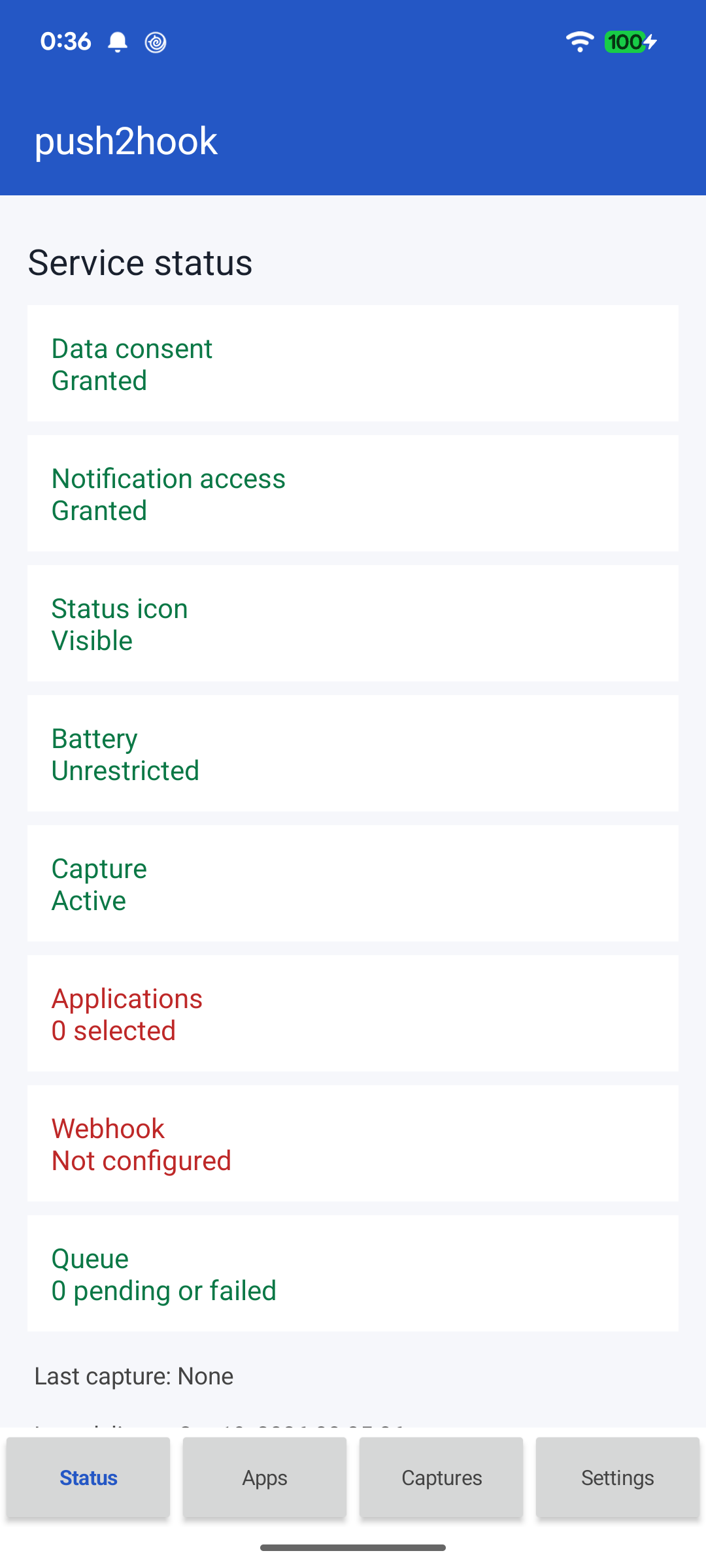
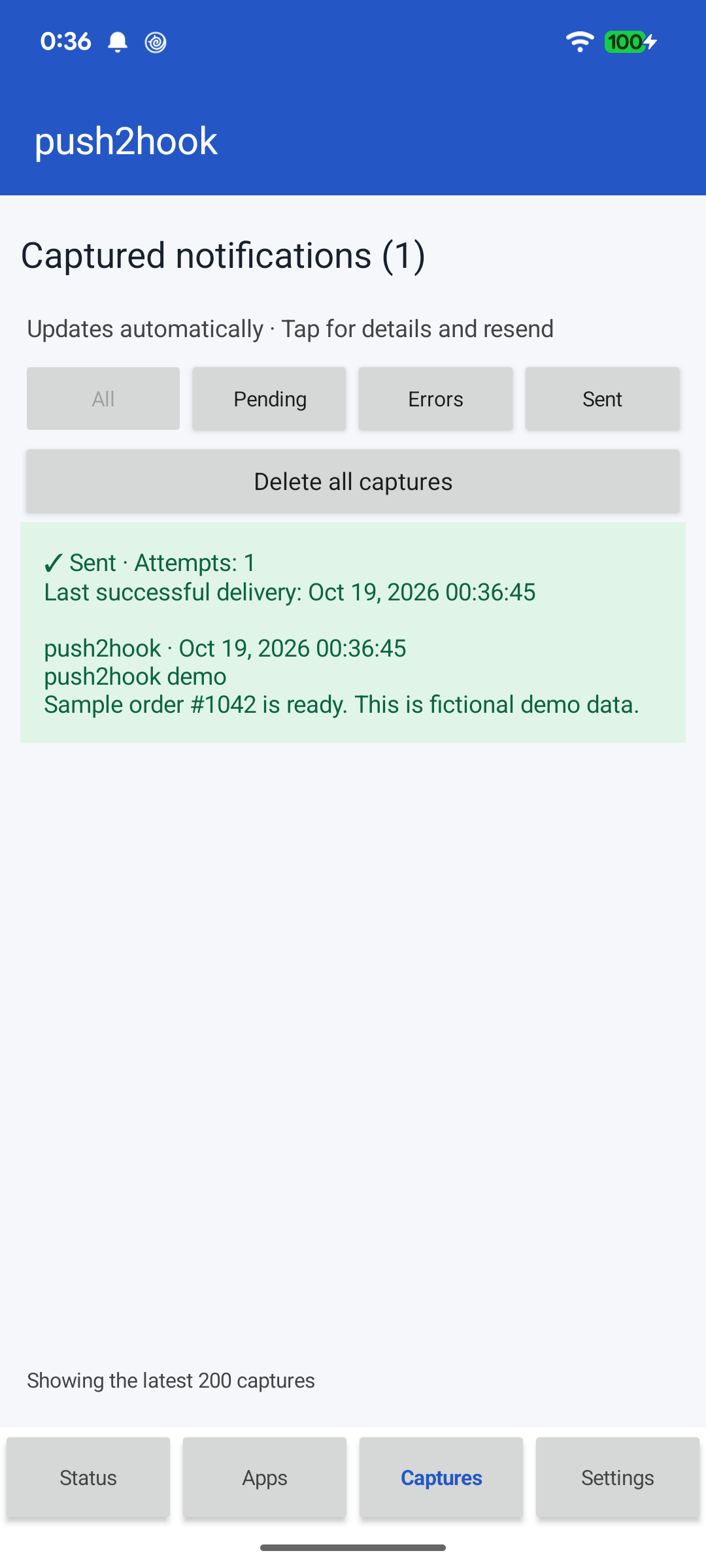
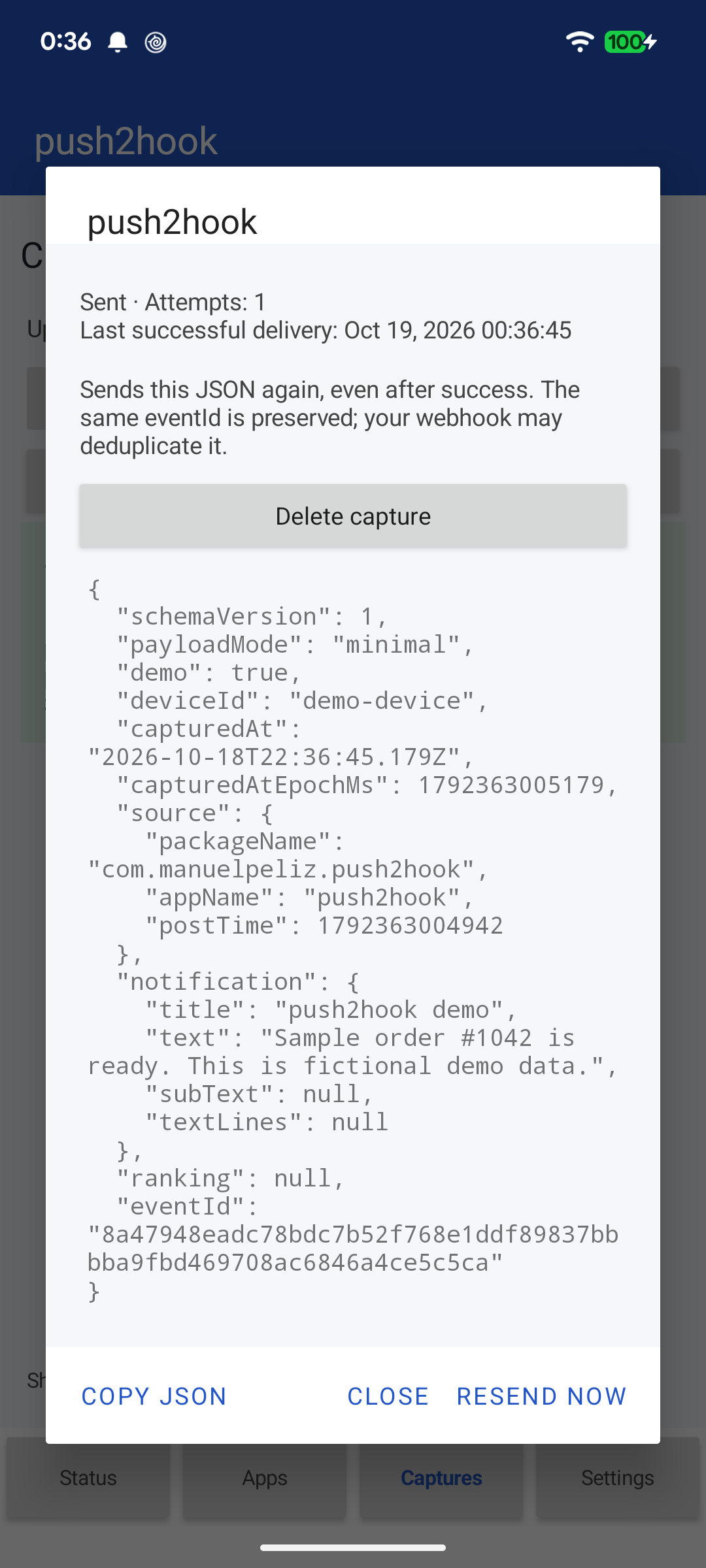
Example request body; X-Device-Id must match deviceId. X-Timestamp is the current Unix time in seconds, not capturedAt.
POST /webhook HTTP/1.1
Content-Type: application/json; charset=utf-8
X-Device-Id: my-phone
X-Timestamp: <unix-seconds>
X-Signature: <Base64 HMAC-SHA256>{
"schemaVersion": 1,
"payloadMode": "minimal",
"demo": false,
"deviceId": "my-phone",
"eventId": "stable-event-id",
"capturedAt": "2026-10-19T10:30:00Z",
"source": {
"packageName": "com.example.orders",
"appName": "Orders",
"postTime": 1792405800000
},
"notification": {
"title": "Order ready",
"text": "Example order #1042",
"subText": null,
"textLines": null
},
"ranking": null
}X-Signature = Base64(HMAC-SHA256(secret, timestamp + "." + rawBody))
View server receiverYour server receives the POST shown above. Choose Node.js, PHP or Python to validate and store the notification.
View outgoing JSONNode.js 20+, no dependencies. Run node receiver.mjs behind an HTTPS reverse proxy; it listens only on 127.0.0.1:8000 (or PORT).
// Node.js 20+, standard library only. Run behind an HTTPS reverse proxy:
// node receiver.mjs (listens on 127.0.0.1:8000, or PORT).
// Configure PUSH2HOOK_DEVICE_ID, PUSH2HOOK_SECRET (32+ UTF-8 bytes),
// PUSH2HOOK_INBOX: an existing private directory outside the web root.
import { createServer } from 'node:http';
import { createHash, createHmac, randomUUID, timingSafeEqual } from 'node:crypto';
import * as fs from 'node:fs/promises';
import { isAbsolute, join } from 'node:path';
import { TextDecoder } from 'node:util';

const MAX_BODY = 1048576;
const isObject = value => value !== null && typeof value === 'object' && !Array.isArray(value);

const server = createServer(async (request, response) => {
  const reply = (status, message = '') => {
    request.resume();
    const body = message ? JSON.stringify({ error: message }) : '';
    response.writeHead(status, {
      'Content-Type': 'application/json; charset=utf-8',
      'Cache-Control': 'no-store', 'X-Content-Type-Options': 'nosniff',
      'Content-Length': Buffer.byteLength(body), ...(status === 405 ? { Allow: 'POST' } : {}),
    });
    response.end(body);
  };
  const header = name => typeof request.headers[name] === 'string' ? request.headers[name] : '';
  let temporary;
  try {
    if (request.method !== 'POST') return reply(405, 'POST required');
    if (header('content-type').split(';', 1)[0].trim().toLowerCase() !== 'application/json') {
      return reply(415, 'application/json required');
    }
    const device = process.env.PUSH2HOOK_DEVICE_ID || '';
    const secret = Buffer.from(process.env.PUSH2HOOK_SECRET || '', 'utf8');
    const inbox = process.env.PUSH2HOOK_INBOX || '';
    if (!device || secret.length < 32 || !isAbsolute(inbox) || !(await fs.stat(inbox)).isDirectory()) {
      return reply(503, 'Receiver not configured');
    }
    const timestamp = header('x-timestamp');
    const signature = header('x-signature');
    if (header('x-device-id') !== device || !/^[0-9]{1,12}$/.test(timestamp)
        || Math.abs(Math.floor(Date.now() / 1000) - Number(timestamp)) > 300
        || !/^[A-Za-z0-9+/]{43}=$/.test(signature)) {
      return reply(401, 'Authentication failed');
    }
    const length = header('content-length');
    if (!/^[0-9]{1,10}$/.test(length)) return reply(411, 'Content-Length required');
    if (Number(length) > MAX_BODY) return reply(413, 'Body too large');
    const chunks = [];
    let size = 0;
    for await (const chunk of request) {
      size += chunk.length;
      if (size > MAX_BODY) return reply(413, 'Body too large');
      chunks.push(chunk);
    }
    const raw = Buffer.concat(chunks);
    if (raw.length !== Number(length)) return reply(400, 'Incomplete body');

    // HMAC uses ORIGINAL bytes. Never parse/re-serialize JSON before verification.
    const expected = createHmac('sha256', secret).update(timestamp + '.', 'utf8').update(raw).digest();
    const supplied = Buffer.from(signature, 'base64');
    if (supplied.length !== 32 || !timingSafeEqual(expected, supplied)) {
      return reply(401, 'Authentication failed');
    }
    let data;
    try {
      data = JSON.parse(new TextDecoder('utf-8', { fatal: true }).decode(raw));
    } catch {
      return reply(400, 'Invalid JSON');
    }
    if (!isObject(data) || data.schemaVersion !== 1 || data.deviceId !== device || data.demo !== false
        || typeof data.eventId !== 'string' || data.eventId.length < 1 || data.eventId.length > 200
        || /[^A-Za-z0-9._:-]/.test(data.eventId) || !isObject(data.source)
        || typeof data.source.packageName !== 'string' || !data.source.packageName
        || Buffer.byteLength(data.source.packageName, 'utf8') > 255
        || !isObject(data.notification) || Object.keys(data.notification).length === 0) {
      return reply(400, 'Invalid notification or device mismatch');
    }

    // Publish a complete private inbox file atomically, without overwriting an
    // existing device + eventId. Process these files asynchronously.
    const key = createHash('sha256').update(device + '\0' + data.eventId, 'utf8').digest('hex');
    const target = join(inbox, key + '.json');
    temporary = join(inbox, '.pending-' + randomUUID());
    const output = await fs.open(temporary, 'wx', 0o600);
    try {
      await output.writeFile(raw);
      await output.sync();
    } finally {
      await output.close();
    }
    let duplicate = false;
    try {
      await fs.link(temporary, target);
    } catch (error) {
      if (error.code !== 'EEXIST' || !(await fs.stat(target)).isFile()) throw error;
      duplicate = true;
    }
    reply(duplicate ? 204 : 202);
  } catch {
    // A failed write must return 5xx so push2hook can retry.
    if (!response.headersSent) reply(503, 'Storage unavailable');
  } finally {
    if (temporary) await fs.unlink(temporary).catch(() => {});
  }
});
server.requestTimeout = 15000;
server.headersTimeout = 10000;
server.listen(Number(process.env.PORT || 8000), '127.0.0.1');
PHP 8.1+, no extensions required. Deploy receiver.php through your HTTPS web server and configure the environment in PHP-FPM.
<?php
declare(strict_types=1);

// PHP 8.1+. Configure these variables in the PHP-FPM process environment.
// PUSH2HOOK_DEVICE_ID, PUSH2HOOK_SECRET (32+ bytes), PUSH2HOOK_INBOX.
// Serve behind HTTPS. The inbox directory must be private and outside the web root.
header('Content-Type: application/json; charset=utf-8');
header('Cache-Control: no-store');
header('X-Content-Type-Options: nosniff');

function reply(int $status, string $message = ''): never {
    http_response_code($status);
    if ($message !== '') echo json_encode(['error' => $message]);
    exit;
}

if (($_SERVER['REQUEST_METHOD'] ?? '') !== 'POST') {
    header('Allow: POST');
    reply(405, 'POST required');
}
if (strtolower(trim(explode(';', $_SERVER['CONTENT_TYPE'] ?? '')[0])) !== 'application/json') {
    reply(415, 'application/json required');
}

$device = getenv('PUSH2HOOK_DEVICE_ID') ?: '';
$secret = getenv('PUSH2HOOK_SECRET') ?: '';
$inbox = getenv('PUSH2HOOK_INBOX') ?: '';
if ($device === '' || strlen($secret) < 32 || $inbox === '' || $inbox[0] !== '/' || !is_dir($inbox)) {
    reply(503, 'Receiver not configured');
}

$deviceHeader = $_SERVER['HTTP_X_DEVICE_ID'] ?? '';
$timestamp = $_SERVER['HTTP_X_TIMESTAMP'] ?? '';
$signature = $_SERVER['HTTP_X_SIGNATURE'] ?? '';
$now = time();
if (!hash_equals($device, $deviceHeader) || !preg_match('/\A[0-9]{1,12}\z/', $timestamp) ||
    abs($now - (int)$timestamp) > 300 || strlen($signature) > 128) {
    reply(401, 'Authentication failed');
}

const MAX_BODY = 1048576;
if ((int)($_SERVER['CONTENT_LENGTH'] ?? 0) > MAX_BODY) reply(413, 'Body too large');
$raw = file_get_contents('php://input', false, null, 0, MAX_BODY + 1);
if ($raw === false || strlen($raw) > MAX_BODY) reply(413, 'Body too large');

// Sign the ORIGINAL bytes: never decode/re-encode JSON before checking HMAC.
// Base64(HMAC-SHA256(UTF8(secret), UTF8(timestamp + ".") + rawBody)).
$supplied = base64_decode($signature, true);
$expected = hash_hmac('sha256', $timestamp . '.' . $raw, $secret, true);
if ($supplied === false || strlen($supplied) !== 32 || !hash_equals($expected, $supplied)) {
    reply(401, 'Authentication failed');
}

try {
    $data = json_decode($raw, true, 64, JSON_THROW_ON_ERROR);
} catch (JsonException $error) {
    reply(400, 'Invalid JSON');
}
if (!is_array($data) || ($data['schemaVersion'] ?? null) !== 1 ||
    ($data['deviceId'] ?? null) !== $device || ($data['demo'] ?? null) !== false ||
    !is_string($data['eventId'] ?? null) ||
    !preg_match('/\A[A-Za-z0-9._:-]{1,200}\z/', $data['eventId']) ||
    !is_array($data['source'] ?? null) || !is_string($data['source']['packageName'] ?? null) ||
    $data['source']['packageName'] === '' || strlen($data['source']['packageName']) > 255 ||
    !is_array($data['notification'] ?? null) || array_is_list($data['notification'])) {
    reply(400, 'Invalid notification or device mismatch');
}

// A persistent inbox, keyed by device + eventId. Retries are acknowledged without
// storing a second copy. Process these files asynchronously in your automation.
$path = $inbox . '/' . hash('sha256', $device . "\0" . $data['eventId']) . '.json';
$temporary = null;
$lock = null;
$output = null;
$duplicate = false;
$oldMask = umask(0077);
try {
    $lock = @fopen($inbox . '/.lock', 'c');
    if ($lock === false || !flock($lock, LOCK_EX)) throw new RuntimeException();
    $duplicate = is_file($path);
    if (!$duplicate) {
        $temporary = tempnam($inbox, '.pending-');
        if ($temporary === false) throw new RuntimeException();
        $output = fopen($temporary, 'wb');
        if ($output === false) throw new RuntimeException();
        $offset = 0;
        while ($offset < strlen($raw)) {
            $written = fwrite($output, substr($raw, $offset));
            if ($written === false || $written === 0) throw new RuntimeException();
            $offset += $written;
        }
        if (!fflush($output) || !fsync($output)) throw new RuntimeException();
        fclose($output);
        $output = null;
        if (!rename($temporary, $path)) throw new RuntimeException();
        $temporary = null;
    }
} catch (Throwable $error) {
    // A 5xx response asks push2hook to retry; never acknowledge failed storage.
    $failed = true;
} finally {
    if (is_resource($output)) fclose($output);
    if (is_string($temporary) && is_file($temporary)) unlink($temporary);
    if (is_resource($lock)) { flock($lock, LOCK_UN); fclose($lock); }
    umask($oldMask);
}
if (isset($failed)) reply(503, 'Storage unavailable');
reply($duplicate ? 204 : 202);
Python 3.10+, Linux/macOS. Deploy application through a production WSGI server behind HTTPS. python3 receiver.py is only a local development server.
"""Python 3.10+, Linux/macOS. Expose application through a WSGI server + HTTPS.

Configure PUSH2HOOK_DEVICE_ID, PUSH2HOOK_SECRET (32+ UTF-8 bytes), PUSH2HOOK_INBOX.
The inbox must be an existing private directory, outside your web root.
python3 receiver.py starts a loopback-only DEVELOPMENT server, port 8000.
"""
import base64
import binascii
import fcntl
import hashlib
import hmac
import json
import os
from pathlib import Path
import re
import tempfile
import time
from http import HTTPStatus

MAX_BODY = 1048576


def application(environ, start_response):
    def reply(status, message=""):
        body = json.dumps({"error": message}).encode() if message else b""
        headers = [("Content-Type", "application/json; charset=utf-8"),
                   ("Cache-Control", "no-store"), ("X-Content-Type-Options", "nosniff"),
                   ("Content-Length", str(len(body)))]
        if status == 405:
            headers.append(("Allow", "POST"))
        start_response(f"{status} {HTTPStatus(status).phrase}", headers)
        return [body]

    if environ.get("REQUEST_METHOD") != "POST":
        return reply(405, "POST required")
    if environ.get("CONTENT_TYPE", "").split(";", 1)[0].strip().lower() != "application/json":
        return reply(415, "application/json required")

    device = os.environ.get("PUSH2HOOK_DEVICE_ID", "")
    secret = os.environ.get("PUSH2HOOK_SECRET", "").encode("utf-8")
    inbox = Path(os.environ.get("PUSH2HOOK_INBOX", "."))
    if not device or len(secret) < 32 or not inbox.is_absolute() or not inbox.is_dir():
        return reply(503, "Receiver not configured")

    device_header = environ.get("HTTP_X_DEVICE_ID", "")
    timestamp = environ.get("HTTP_X_TIMESTAMP", "")
    signature = environ.get("HTTP_X_SIGNATURE", "")
    now = int(time.time())
    if (not hmac.compare_digest(device.encode("utf-8"), device_header.encode("utf-8"))
            or not re.fullmatch(r"[0-9]{1,12}", timestamp)
            or abs(now - int(timestamp)) > 300 or len(signature) > 128):
        return reply(401, "Authentication failed")

    length = environ.get("CONTENT_LENGTH", "")
    if not re.fullmatch(r"[0-9]{1,10}", length):
        return reply(411, "Content-Length required")
    length = int(length)
    if length > MAX_BODY:
        return reply(413, "Body too large")
    raw = environ["wsgi.input"].read(length)
    if len(raw) != length:
        return reply(400, "Incomplete body")

    # Verify ORIGINAL bytes; do not decode/re-encode JSON before checking HMAC.
    expected = hmac.digest(secret, timestamp.encode("ascii") + b"." + raw, "sha256")
    try:
        supplied = base64.b64decode(signature, validate=True)
    except (ValueError, binascii.Error):
        return reply(401, "Authentication failed")
    if len(supplied) != 32 or not hmac.compare_digest(expected, supplied):
        return reply(401, "Authentication failed")

    try:
        data = json.loads(raw.decode("utf-8"))
    except (ValueError, UnicodeError, RecursionError):
        return reply(400, "Invalid JSON")
    if (not isinstance(data, dict) or type(data.get("schemaVersion")) is not int
            or data["schemaVersion"] != 1 or data.get("deviceId") != device
            or data.get("demo") is not False or not isinstance(data.get("eventId"), str)
            or not re.fullmatch(r"[A-Za-z0-9._:-]{1,200}", data["eventId"])
            or not isinstance(data.get("source"), dict)
            or not isinstance(data["source"].get("packageName"), str)
            or not 1 <= len(data["source"]["packageName"].encode("utf-8")) <= 255
            or not isinstance(data.get("notification"), dict) or not data["notification"]):
        return reply(400, "Invalid notification or device mismatch")

    # Stable inbox key: acknowledge retries, but never store a second copy.
    key = hashlib.sha256((device + "\0" + data["eventId"]).encode("utf-8")).hexdigest()
    target = inbox / f"{key}.json"
    temporary = None
    try:
        descriptor = os.open(inbox / ".lock", os.O_CREAT | os.O_WRONLY, 0o600)
        with os.fdopen(descriptor, "wb") as lock:
            fcntl.flock(lock, fcntl.LOCK_EX)
            duplicate = target.is_file()
            if not duplicate:
                descriptor, temporary = tempfile.mkstemp(prefix=".pending-", dir=inbox)
                with os.fdopen(descriptor, "wb") as output:
                    output.write(raw)
                    output.flush()
                    os.fsync(output.fileno())
                os.replace(temporary, target)
                temporary = None
    except OSError:
        # 5xx asks push2hook to retry. A failed write must never return success.
        return reply(503, "Storage unavailable")
    finally:
        if temporary is not None:
            Path(temporary).unlink(missing_ok=True)
    return reply(204 if duplicate else 202)


if __name__ == "__main__":
    from wsgiref.simple_server import make_server
    with make_server("127.0.0.1", int(os.environ.get("PORT", "8000")), application) as server:
        server.serve_forever()
In the app, choose your own HTTPS URL, device ID my-phone and a random HMAC secret of at least 32 characters. Configure the same values in your server process. Use a separate secret for each device; this is unrelated to the Android signing key.
Server environment (replace the secret; create a private inbox directory outside the web root, writable by the receiver):
PUSH2HOOK_DEVICE_ID=my-phone
PUSH2HOOK_SECRET='PASTE_YOUR_RANDOM_SECRET_HERE'
PUSH2HOOK_INBOX=/var/lib/push2hook/inbox
Validation: POST + JSON, configured device, timestamp within ±5 minutes, Base64 HMAC-SHA256 over the original request bytes, constant-time signature comparison, matching JSON deviceId, schema and eventId. Keep phone and server clocks synchronized.
A valid event is stored as a private JSON inbox file, then returns 202. Process those files in your automation. Atomic file publication prevents duplicate storage; the same device + eventId returns 204. Deleting a file also removes its deduplication record. Apply your own retention policy and keep the inbox private.
The app treats 2xx as success, retries 5xx/network errors (also 408/429), and marks other 4xx as failed. A manual resend keeps eventId, so these receivers acknowledge an existing event without processing it again. Never execute notification text as code or shell commands.
Six languages, selected automatically from your phone: English, Spanish, French, German, Portuguese and Italian. You can also choose the app language in Android settings.
Real notifications go to the HTTPS endpoints you configure. The optional demo sends only a generated fictional sample to manuelpeliz.es, using a fixed demo identifier.
Leaving the screen keeps capture enabled. Android permissions, network, battery restrictions and device policies affect background delivery. Force stop in Android stops the app.
Yes. Resend preserves the original eventId and payload. Your webhook may deduplicate that ID, so review the receiver’s rules.
It is a personal automation tool for your own notifications. It is not designed for covert monitoring or monitoring other people.