Choisissez les données envoyées
Aucune appli n’est sélectionnée automatiquement. Choisissez applis, mots-clés facultatifs et destinations.
 Push Notifications to Webhook
Android · HTTPS · Webhooks
Transférez les notifications des applis Android choisies vers vos webhooks HTTPS. Filtrez par mots-clés, suivez les envois et gardez le contrôle.
Android 12+ · Publication en préparationAucune appli n’est sélectionnée automatiquement. Choisissez applis, mots-clés facultatifs et destinations.
Historique en direct : en attente, en cours, livré ou en échec. Renvoyez même une notification déjà livrée.
La capture continue lorsque vous quittez l’écran. Fermer et arrêter suspend capture et envois jusqu’à la prochaine ouverture.
HTTPS, signature HMAC-SHA256 facultative, Wi-Fi uniquement et conservation locale configurable.
Lisez les informations et acceptez pour activer la capture. Le consentement peut être retiré dans Réglages.
Android demande une autorisation séparée. Vérifiez l’avis de fonctionnement et les restrictions de batterie.
Saisissez une URL HTTPS dans Réglages, puis choisissez les applis et mots-clés. Une URL distincte par appli est possible.
Captures affiche état, tentatives et JSON. Essayez la démo fictive avant de connecter votre intégration.
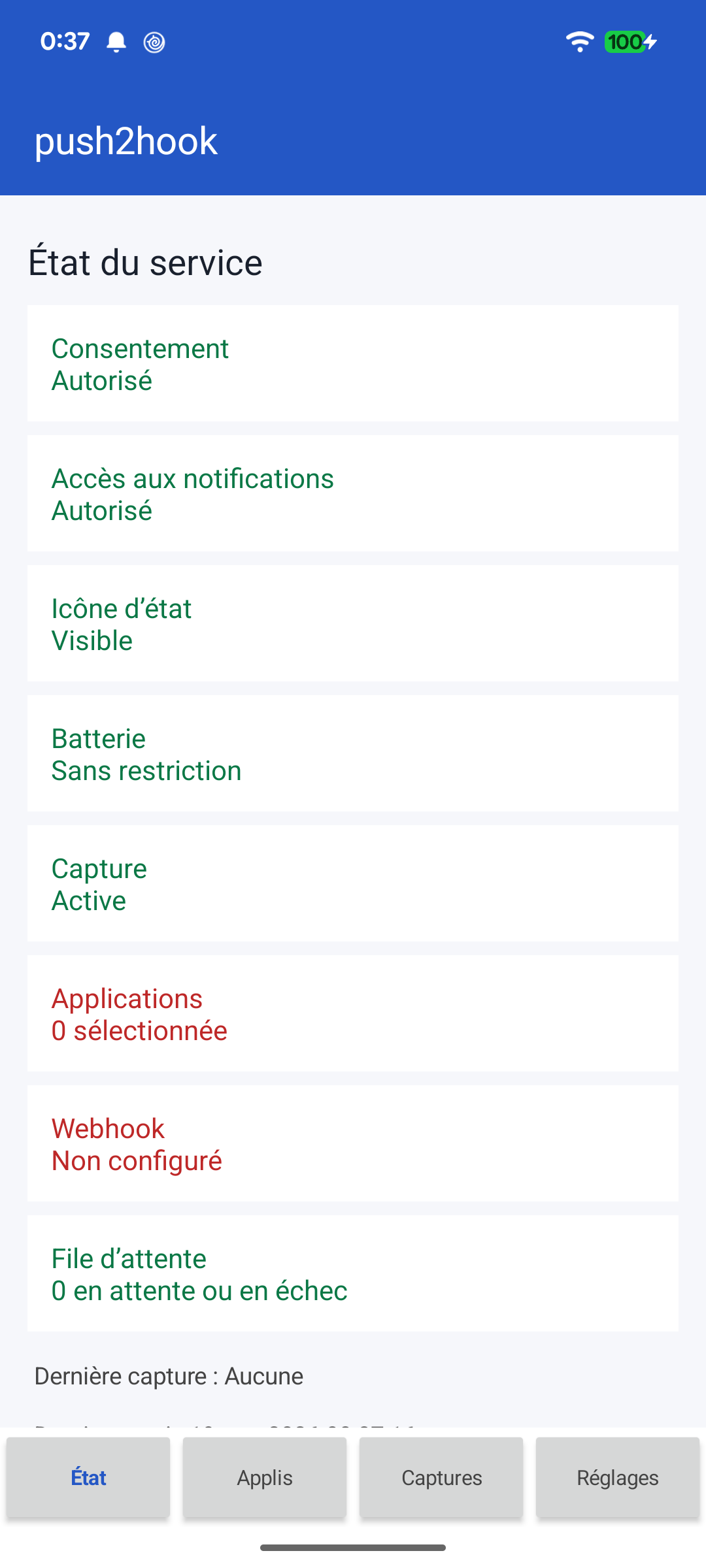
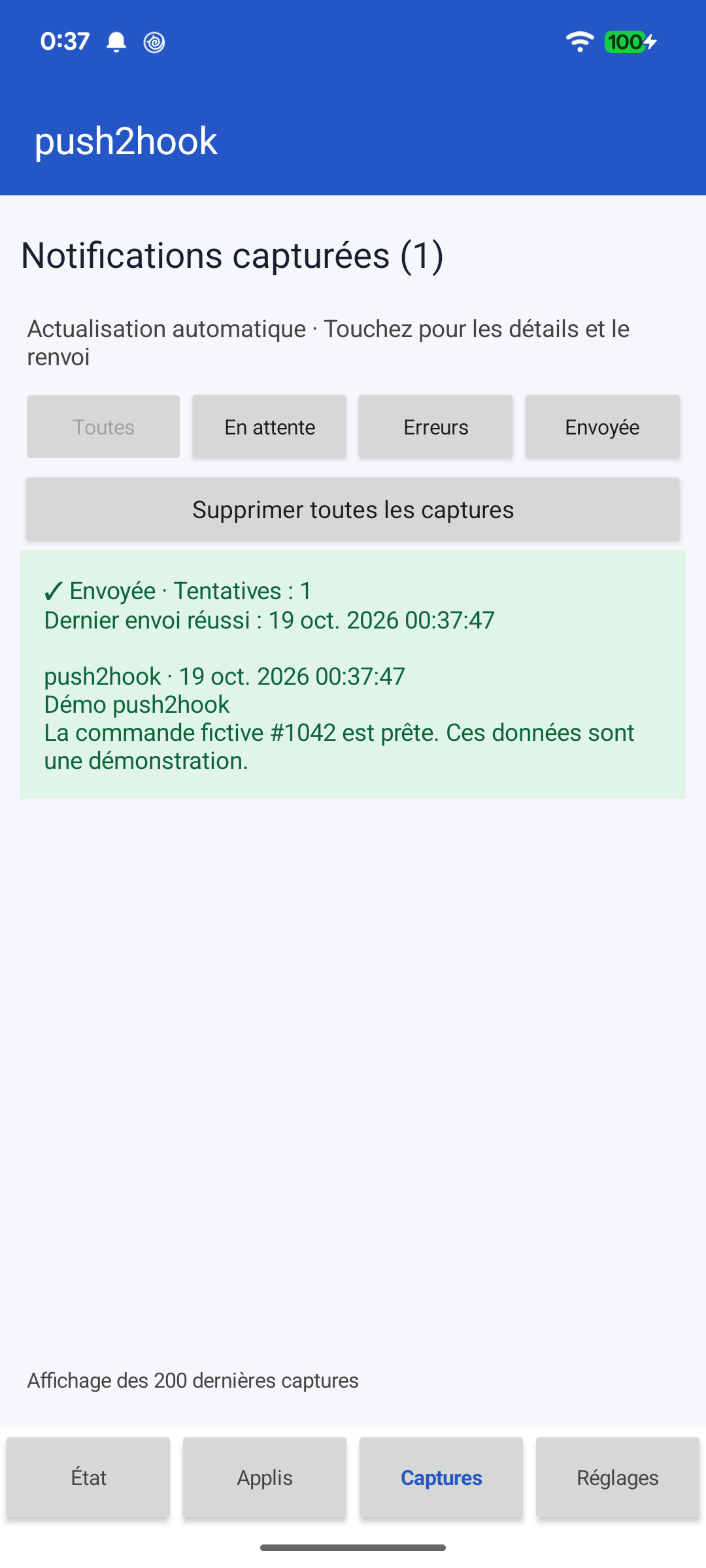
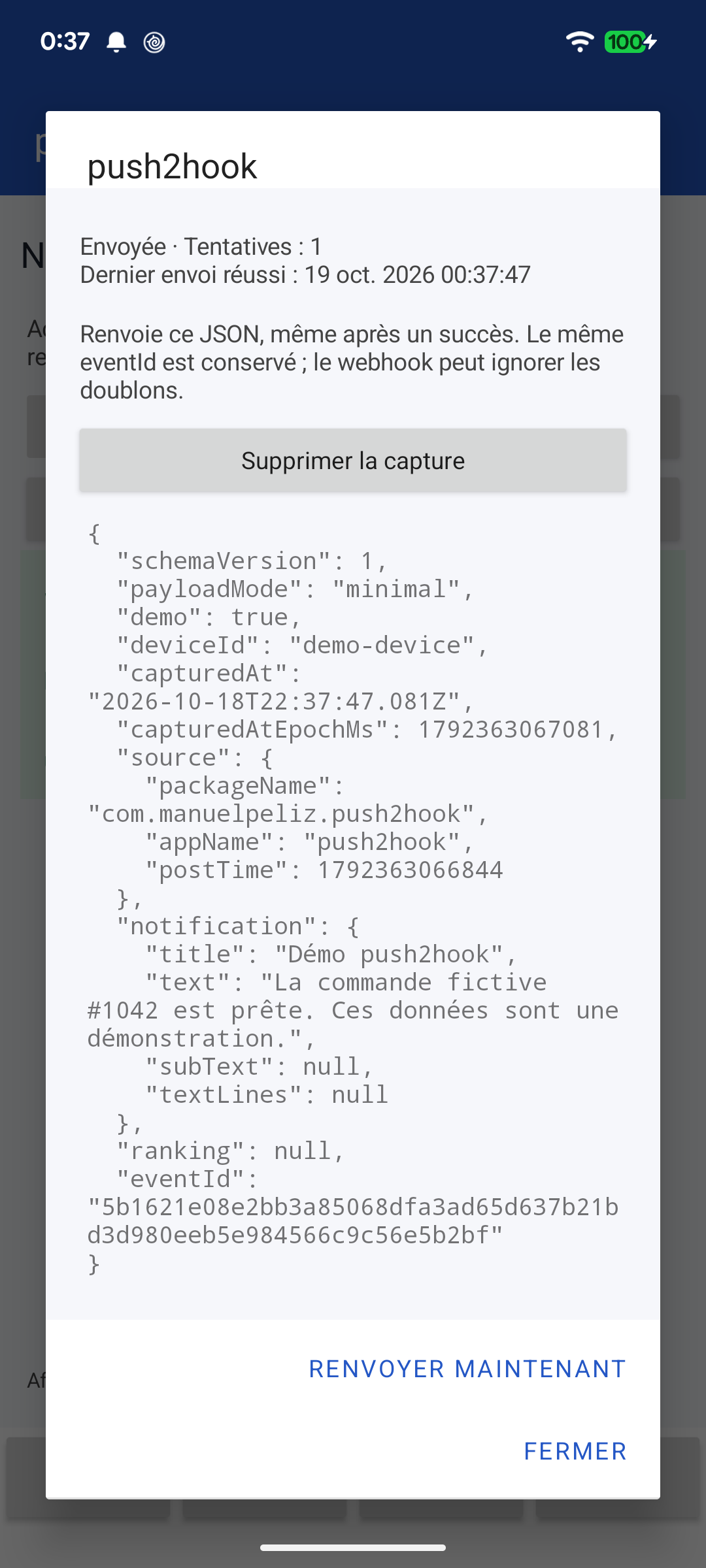
Exemple du corps : X-Device-Id doit correspondre à deviceId. X-Timestamp est l’heure Unix actuelle en secondes, pas capturedAt.
POST /webhook HTTP/1.1
Content-Type: application/json; charset=utf-8
X-Device-Id: my-phone
X-Timestamp: <unix-seconds>
X-Signature: <Base64 HMAC-SHA256>{
"schemaVersion": 1,
"payloadMode": "minimal",
"demo": false,
"deviceId": "my-phone",
"eventId": "stable-event-id",
"capturedAt": "2026-10-19T10:30:00Z",
"source": {
"packageName": "com.example.orders",
"appName": "Orders",
"postTime": 1792405800000
},
"notification": {
"title": "Order ready",
"text": "Example order #1042",
"subText": null,
"textLines": null
},
"ranking": null
}X-Signature = Base64(HMAC-SHA256(secret, timestamp + "." + rawBody))
Voir le récepteur serveurVotre serveur reçoit le POST ci-dessus. Choisissez Node.js, PHP ou Python pour vérifier et enregistrer la notification.
Voir le JSON envoyéNode.js 20+, sans dépendances. Lancez node receiver.mjs derrière un proxy HTTPS ; écoute uniquement sur 127.0.0.1:8000 (ou PORT).
// Node.js 20+, standard library only. Run behind an HTTPS reverse proxy:
// node receiver.mjs (listens on 127.0.0.1:8000, or PORT).
// Configure PUSH2HOOK_DEVICE_ID, PUSH2HOOK_SECRET (32+ UTF-8 bytes),
// PUSH2HOOK_INBOX: an existing private directory outside the web root.
import { createServer } from 'node:http';
import { createHash, createHmac, randomUUID, timingSafeEqual } from 'node:crypto';
import * as fs from 'node:fs/promises';
import { isAbsolute, join } from 'node:path';
import { TextDecoder } from 'node:util';

const MAX_BODY = 1048576;
const isObject = value => value !== null && typeof value === 'object' && !Array.isArray(value);

const server = createServer(async (request, response) => {
  const reply = (status, message = '') => {
    request.resume();
    const body = message ? JSON.stringify({ error: message }) : '';
    response.writeHead(status, {
      'Content-Type': 'application/json; charset=utf-8',
      'Cache-Control': 'no-store', 'X-Content-Type-Options': 'nosniff',
      'Content-Length': Buffer.byteLength(body), ...(status === 405 ? { Allow: 'POST' } : {}),
    });
    response.end(body);
  };
  const header = name => typeof request.headers[name] === 'string' ? request.headers[name] : '';
  let temporary;
  try {
    if (request.method !== 'POST') return reply(405, 'POST required');
    if (header('content-type').split(';', 1)[0].trim().toLowerCase() !== 'application/json') {
      return reply(415, 'application/json required');
    }
    const device = process.env.PUSH2HOOK_DEVICE_ID || '';
    const secret = Buffer.from(process.env.PUSH2HOOK_SECRET || '', 'utf8');
    const inbox = process.env.PUSH2HOOK_INBOX || '';
    if (!device || secret.length < 32 || !isAbsolute(inbox) || !(await fs.stat(inbox)).isDirectory()) {
      return reply(503, 'Receiver not configured');
    }
    const timestamp = header('x-timestamp');
    const signature = header('x-signature');
    if (header('x-device-id') !== device || !/^[0-9]{1,12}$/.test(timestamp)
        || Math.abs(Math.floor(Date.now() / 1000) - Number(timestamp)) > 300
        || !/^[A-Za-z0-9+/]{43}=$/.test(signature)) {
      return reply(401, 'Authentication failed');
    }
    const length = header('content-length');
    if (!/^[0-9]{1,10}$/.test(length)) return reply(411, 'Content-Length required');
    if (Number(length) > MAX_BODY) return reply(413, 'Body too large');
    const chunks = [];
    let size = 0;
    for await (const chunk of request) {
      size += chunk.length;
      if (size > MAX_BODY) return reply(413, 'Body too large');
      chunks.push(chunk);
    }
    const raw = Buffer.concat(chunks);
    if (raw.length !== Number(length)) return reply(400, 'Incomplete body');

    // HMAC uses ORIGINAL bytes. Never parse/re-serialize JSON before verification.
    const expected = createHmac('sha256', secret).update(timestamp + '.', 'utf8').update(raw).digest();
    const supplied = Buffer.from(signature, 'base64');
    if (supplied.length !== 32 || !timingSafeEqual(expected, supplied)) {
      return reply(401, 'Authentication failed');
    }
    let data;
    try {
      data = JSON.parse(new TextDecoder('utf-8', { fatal: true }).decode(raw));
    } catch {
      return reply(400, 'Invalid JSON');
    }
    if (!isObject(data) || data.schemaVersion !== 1 || data.deviceId !== device || data.demo !== false
        || typeof data.eventId !== 'string' || data.eventId.length < 1 || data.eventId.length > 200
        || /[^A-Za-z0-9._:-]/.test(data.eventId) || !isObject(data.source)
        || typeof data.source.packageName !== 'string' || !data.source.packageName
        || Buffer.byteLength(data.source.packageName, 'utf8') > 255
        || !isObject(data.notification) || Object.keys(data.notification).length === 0) {
      return reply(400, 'Invalid notification or device mismatch');
    }

    // Publish a complete private inbox file atomically, without overwriting an
    // existing device + eventId. Process these files asynchronously.
    const key = createHash('sha256').update(device + '\0' + data.eventId, 'utf8').digest('hex');
    const target = join(inbox, key + '.json');
    temporary = join(inbox, '.pending-' + randomUUID());
    const output = await fs.open(temporary, 'wx', 0o600);
    try {
      await output.writeFile(raw);
      await output.sync();
    } finally {
      await output.close();
    }
    let duplicate = false;
    try {
      await fs.link(temporary, target);
    } catch (error) {
      if (error.code !== 'EEXIST' || !(await fs.stat(target)).isFile()) throw error;
      duplicate = true;
    }
    reply(duplicate ? 204 : 202);
  } catch {
    // A failed write must return 5xx so push2hook can retry.
    if (!response.headersSent) reply(503, 'Storage unavailable');
  } finally {
    if (temporary) await fs.unlink(temporary).catch(() => {});
  }
});
server.requestTimeout = 15000;
server.headersTimeout = 10000;
server.listen(Number(process.env.PORT || 8000), '127.0.0.1');
PHP 8.1+, sans extension supplémentaire. Servez receiver.php via votre serveur HTTPS et configurez les variables PHP-FPM.
<?php
declare(strict_types=1);

// PHP 8.1+. Configure these variables in the PHP-FPM process environment.
// PUSH2HOOK_DEVICE_ID, PUSH2HOOK_SECRET (32+ bytes), PUSH2HOOK_INBOX.
// Serve behind HTTPS. The inbox directory must be private and outside the web root.
header('Content-Type: application/json; charset=utf-8');
header('Cache-Control: no-store');
header('X-Content-Type-Options: nosniff');

function reply(int $status, string $message = ''): never {
    http_response_code($status);
    if ($message !== '') echo json_encode(['error' => $message]);
    exit;
}

if (($_SERVER['REQUEST_METHOD'] ?? '') !== 'POST') {
    header('Allow: POST');
    reply(405, 'POST required');
}
if (strtolower(trim(explode(';', $_SERVER['CONTENT_TYPE'] ?? '')[0])) !== 'application/json') {
    reply(415, 'application/json required');
}

$device = getenv('PUSH2HOOK_DEVICE_ID') ?: '';
$secret = getenv('PUSH2HOOK_SECRET') ?: '';
$inbox = getenv('PUSH2HOOK_INBOX') ?: '';
if ($device === '' || strlen($secret) < 32 || $inbox === '' || $inbox[0] !== '/' || !is_dir($inbox)) {
    reply(503, 'Receiver not configured');
}

$deviceHeader = $_SERVER['HTTP_X_DEVICE_ID'] ?? '';
$timestamp = $_SERVER['HTTP_X_TIMESTAMP'] ?? '';
$signature = $_SERVER['HTTP_X_SIGNATURE'] ?? '';
$now = time();
if (!hash_equals($device, $deviceHeader) || !preg_match('/\A[0-9]{1,12}\z/', $timestamp) ||
    abs($now - (int)$timestamp) > 300 || strlen($signature) > 128) {
    reply(401, 'Authentication failed');
}

const MAX_BODY = 1048576;
if ((int)($_SERVER['CONTENT_LENGTH'] ?? 0) > MAX_BODY) reply(413, 'Body too large');
$raw = file_get_contents('php://input', false, null, 0, MAX_BODY + 1);
if ($raw === false || strlen($raw) > MAX_BODY) reply(413, 'Body too large');

// Sign the ORIGINAL bytes: never decode/re-encode JSON before checking HMAC.
// Base64(HMAC-SHA256(UTF8(secret), UTF8(timestamp + ".") + rawBody)).
$supplied = base64_decode($signature, true);
$expected = hash_hmac('sha256', $timestamp . '.' . $raw, $secret, true);
if ($supplied === false || strlen($supplied) !== 32 || !hash_equals($expected, $supplied)) {
    reply(401, 'Authentication failed');
}

try {
    $data = json_decode($raw, true, 64, JSON_THROW_ON_ERROR);
} catch (JsonException $error) {
    reply(400, 'Invalid JSON');
}
if (!is_array($data) || ($data['schemaVersion'] ?? null) !== 1 ||
    ($data['deviceId'] ?? null) !== $device || ($data['demo'] ?? null) !== false ||
    !is_string($data['eventId'] ?? null) ||
    !preg_match('/\A[A-Za-z0-9._:-]{1,200}\z/', $data['eventId']) ||
    !is_array($data['source'] ?? null) || !is_string($data['source']['packageName'] ?? null) ||
    $data['source']['packageName'] === '' || strlen($data['source']['packageName']) > 255 ||
    !is_array($data['notification'] ?? null) || array_is_list($data['notification'])) {
    reply(400, 'Invalid notification or device mismatch');
}

// A persistent inbox, keyed by device + eventId. Retries are acknowledged without
// storing a second copy. Process these files asynchronously in your automation.
$path = $inbox . '/' . hash('sha256', $device . "\0" . $data['eventId']) . '.json';
$temporary = null;
$lock = null;
$output = null;
$duplicate = false;
$oldMask = umask(0077);
try {
    $lock = @fopen($inbox . '/.lock', 'c');
    if ($lock === false || !flock($lock, LOCK_EX)) throw new RuntimeException();
    $duplicate = is_file($path);
    if (!$duplicate) {
        $temporary = tempnam($inbox, '.pending-');
        if ($temporary === false) throw new RuntimeException();
        $output = fopen($temporary, 'wb');
        if ($output === false) throw new RuntimeException();
        $offset = 0;
        while ($offset < strlen($raw)) {
            $written = fwrite($output, substr($raw, $offset));
            if ($written === false || $written === 0) throw new RuntimeException();
            $offset += $written;
        }
        if (!fflush($output) || !fsync($output)) throw new RuntimeException();
        fclose($output);
        $output = null;
        if (!rename($temporary, $path)) throw new RuntimeException();
        $temporary = null;
    }
} catch (Throwable $error) {
    // A 5xx response asks push2hook to retry; never acknowledge failed storage.
    $failed = true;
} finally {
    if (is_resource($output)) fclose($output);
    if (is_string($temporary) && is_file($temporary)) unlink($temporary);
    if (is_resource($lock)) { flock($lock, LOCK_UN); fclose($lock); }
    umask($oldMask);
}
if (isset($failed)) reply(503, 'Storage unavailable');
reply($duplicate ? 204 : 202);
Python 3.10+, Linux/macOS. Déployez application via un serveur WSGI de production derrière HTTPS. python3 receiver.py sert seulement au développement local.
"""Python 3.10+, Linux/macOS. Expose application through a WSGI server + HTTPS.

Configure PUSH2HOOK_DEVICE_ID, PUSH2HOOK_SECRET (32+ UTF-8 bytes), PUSH2HOOK_INBOX.
The inbox must be an existing private directory, outside your web root.
python3 receiver.py starts a loopback-only DEVELOPMENT server, port 8000.
"""
import base64
import binascii
import fcntl
import hashlib
import hmac
import json
import os
from pathlib import Path
import re
import tempfile
import time
from http import HTTPStatus

MAX_BODY = 1048576


def application(environ, start_response):
    def reply(status, message=""):
        body = json.dumps({"error": message}).encode() if message else b""
        headers = [("Content-Type", "application/json; charset=utf-8"),
                   ("Cache-Control", "no-store"), ("X-Content-Type-Options", "nosniff"),
                   ("Content-Length", str(len(body)))]
        if status == 405:
            headers.append(("Allow", "POST"))
        start_response(f"{status} {HTTPStatus(status).phrase}", headers)
        return [body]

    if environ.get("REQUEST_METHOD") != "POST":
        return reply(405, "POST required")
    if environ.get("CONTENT_TYPE", "").split(";", 1)[0].strip().lower() != "application/json":
        return reply(415, "application/json required")

    device = os.environ.get("PUSH2HOOK_DEVICE_ID", "")
    secret = os.environ.get("PUSH2HOOK_SECRET", "").encode("utf-8")
    inbox = Path(os.environ.get("PUSH2HOOK_INBOX", "."))
    if not device or len(secret) < 32 or not inbox.is_absolute() or not inbox.is_dir():
        return reply(503, "Receiver not configured")

    device_header = environ.get("HTTP_X_DEVICE_ID", "")
    timestamp = environ.get("HTTP_X_TIMESTAMP", "")
    signature = environ.get("HTTP_X_SIGNATURE", "")
    now = int(time.time())
    if (not hmac.compare_digest(device.encode("utf-8"), device_header.encode("utf-8"))
            or not re.fullmatch(r"[0-9]{1,12}", timestamp)
            or abs(now - int(timestamp)) > 300 or len(signature) > 128):
        return reply(401, "Authentication failed")

    length = environ.get("CONTENT_LENGTH", "")
    if not re.fullmatch(r"[0-9]{1,10}", length):
        return reply(411, "Content-Length required")
    length = int(length)
    if length > MAX_BODY:
        return reply(413, "Body too large")
    raw = environ["wsgi.input"].read(length)
    if len(raw) != length:
        return reply(400, "Incomplete body")

    # Verify ORIGINAL bytes; do not decode/re-encode JSON before checking HMAC.
    expected = hmac.digest(secret, timestamp.encode("ascii") + b"." + raw, "sha256")
    try:
        supplied = base64.b64decode(signature, validate=True)
    except (ValueError, binascii.Error):
        return reply(401, "Authentication failed")
    if len(supplied) != 32 or not hmac.compare_digest(expected, supplied):
        return reply(401, "Authentication failed")

    try:
        data = json.loads(raw.decode("utf-8"))
    except (ValueError, UnicodeError, RecursionError):
        return reply(400, "Invalid JSON")
    if (not isinstance(data, dict) or type(data.get("schemaVersion")) is not int
            or data["schemaVersion"] != 1 or data.get("deviceId") != device
            or data.get("demo") is not False or not isinstance(data.get("eventId"), str)
            or not re.fullmatch(r"[A-Za-z0-9._:-]{1,200}", data["eventId"])
            or not isinstance(data.get("source"), dict)
            or not isinstance(data["source"].get("packageName"), str)
            or not 1 <= len(data["source"]["packageName"].encode("utf-8")) <= 255
            or not isinstance(data.get("notification"), dict) or not data["notification"]):
        return reply(400, "Invalid notification or device mismatch")

    # Stable inbox key: acknowledge retries, but never store a second copy.
    key = hashlib.sha256((device + "\0" + data["eventId"]).encode("utf-8")).hexdigest()
    target = inbox / f"{key}.json"
    temporary = None
    try:
        descriptor = os.open(inbox / ".lock", os.O_CREAT | os.O_WRONLY, 0o600)
        with os.fdopen(descriptor, "wb") as lock:
            fcntl.flock(lock, fcntl.LOCK_EX)
            duplicate = target.is_file()
            if not duplicate:
                descriptor, temporary = tempfile.mkstemp(prefix=".pending-", dir=inbox)
                with os.fdopen(descriptor, "wb") as output:
                    output.write(raw)
                    output.flush()
                    os.fsync(output.fileno())
                os.replace(temporary, target)
                temporary = None
    except OSError:
        # 5xx asks push2hook to retry. A failed write must never return success.
        return reply(503, "Storage unavailable")
    finally:
        if temporary is not None:
            Path(temporary).unlink(missing_ok=True)
    return reply(204 if duplicate else 202)


if __name__ == "__main__":
    from wsgiref.simple_server import make_server
    with make_server("127.0.0.1", int(os.environ.get("PORT", "8000")), application) as server:
        server.serve_forever()
Dans l’app, configurez votre URL HTTPS, l’appareil my-phone et un secret HMAC aléatoire d’au moins 32 caractères. Utilisez les mêmes valeurs dans le processus serveur et un secret distinct par appareil. Il ne s’agit pas de la clé de signature Android.
Variables du serveur (remplacez le secret et créez un dossier privé, hors de la racine web, accessible en écriture au récepteur) :
PUSH2HOOK_DEVICE_ID=my-phone
PUSH2HOOK_SECRET='PASTE_YOUR_RANDOM_SECRET_HERE'
PUSH2HOOK_INBOX=/var/lib/push2hook/inbox
Vérifications : POST et JSON, appareil autorisé, date à ±5 minutes, HMAC-SHA256 Base64 sur les octets originaux, comparaison à temps constant, deviceId JSON identique, schéma et eventId. Synchronisez les horloges du téléphone et du serveur.
Un événement valide est enregistré dans un fichier JSON privé, puis reçoit 202. Votre automatisation traite ces fichiers. La publication atomique des fichiers évite les doublons ; même appareil et eventId : 204. Supprimer le fichier supprime aussi sa déduplication. Appliquez votre durée de conservation et protégez ce dossier.
L’app accepte 2xx, réessaie les erreurs réseau et 5xx (ainsi que 408/429), et classe les autres 4xx en échec. Un renvoi manuel conserve eventId : ces récepteurs confirment un événement existant sans le retraiter. N’exécutez jamais le texte des notifications comme code ou commandes.
Six langues selon le téléphone : anglais, espagnol, français, allemand, portugais et italien. La langue peut aussi être choisie dans les réglages Android.
Les vraies notifications vont aux URL HTTPS configurées. La démo facultative envoie seulement un exemple fictif à manuelpeliz.es avec un identifiant fixe.
Quitter l’écran laisse la capture active. Autorisations, réseau, batterie et règles du téléphone affectent les envois. Forcer l’arrêt dans Android arrête l’appli.
Oui. L’eventId et le JSON sont conservés. Votre webhook peut dédupliquer cet identifiant.
C’est un outil d’automatisation de vos propres notifications, sans fonction de surveillance secrète d’autrui.